
Connellsville, PA · Services
One standard of care. Fifteen ways in.
Every service on this page runs through the same evaluation, the same licensed physical therapist, and the same plan with an endpoint. The service is the tool; the standard is what doesn’t change.

Most people don’t arrive already knowing which of these fifteen they need. That’s fine. Deciding is our job, not yours, and it happens at the evaluation, not on this page. Every visit starts the same way regardless of where you land: a cause-first evaluation with a licensed physical therapist, one-on-one, that finds the reason for the problem instead of guessing at the symptom.
From there, care moves through four named phases, Pain, Prime, Perform, Prevent. The first six below are the ones people actually book: a course of care with a beginning and an end. The nine after them are techniques. They live inside a plan, chosen when the evaluation points there, never sold as a separate errand or a standing weekly ritual.
Left alone, the thing that brought you here rarely stays the same size. The shoulder you stopped reaching overhead with teaches the hip and the opposite arm to cover for it, and the covering is its own problem by the time anyone calls. Fifteen entries on a page is not fifteen decisions for you to make. It’s one evaluation, and then a plan with the endpoint said out loud.
The six services people book.
A course of care with a beginning and an end. Read the summaries, or skip them; the evaluation decides either way.
Physical Therapy
Hands-on, cause-first care for pain that’s overstayed its welcome. This is the foundation nearly everyone starts on, and for most people it’s the entire plan. Your evaluation finds the actual source of the problem, not just where it hurts, and treatment begins that same visit. From there you move through Pain, Prime, Perform, and Prevent at your own pace, one-on-one with a licensed physical therapist, every visit. No referral required to start, and no guessing about when it ends: the endpoint is named at evaluation and reviewed with you at every phase.
Orthopedic Therapy
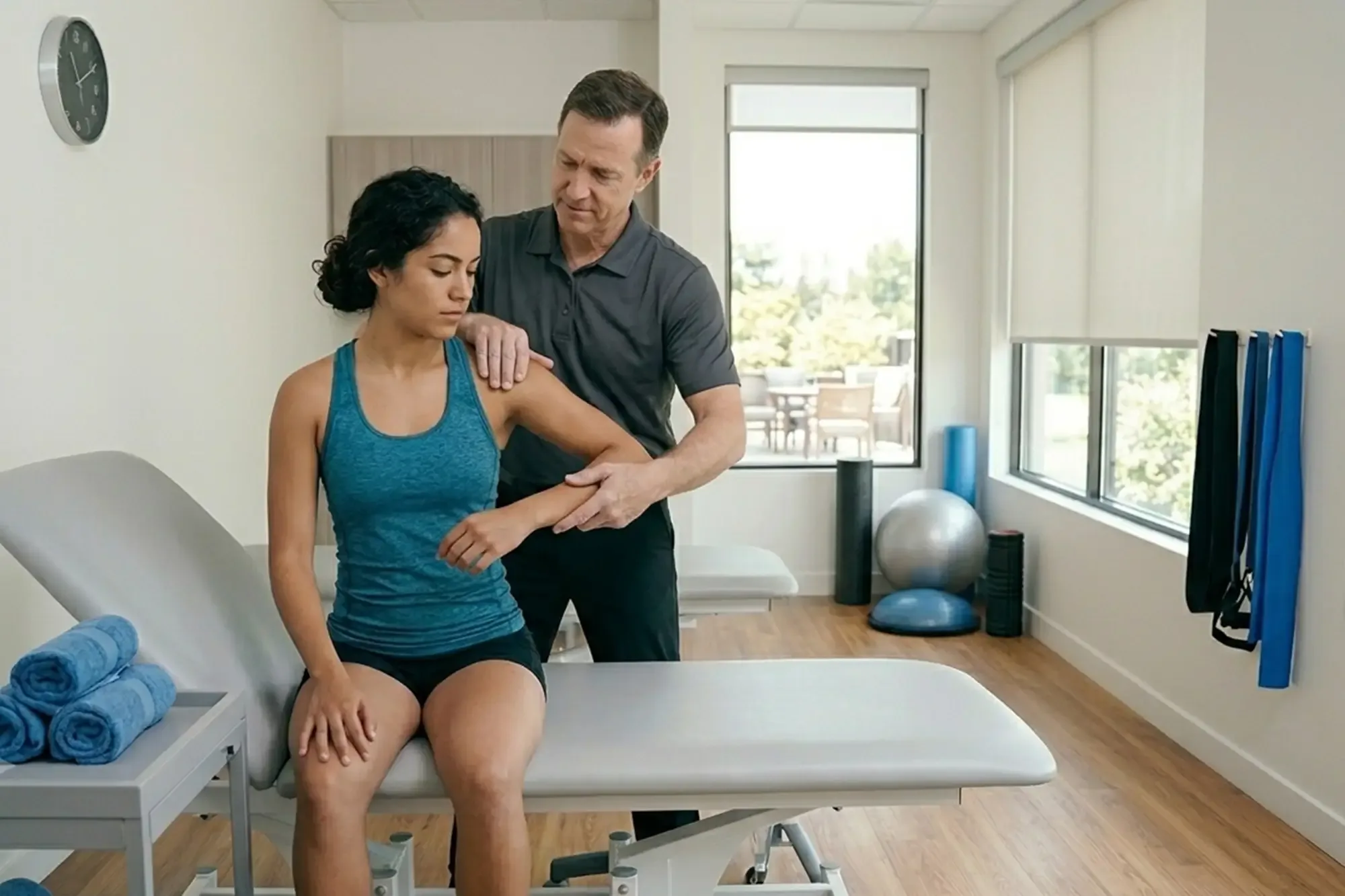
Care aimed at joints, tendons and the mechanics around them: the knee that clicks going down stairs, the hip that stopped rotating a year ago, the shoulder six weeks out of surgery. Orthopedic therapy tests the joint above and the joint below before it treats the one you’re pointing at, because the loudest spot is not reliably the guilty one. Our clinical lead is a Board Certified Orthopaedic Specialist, and the whole staff works to the same standard: test, not guess.

Sports Rehab
Return-to-sport testing you have to pass, not a date circled on a calendar. Sports rehab picks up where general recovery leaves off: strength, agility, and sport-specific movement rebuilt against clearance standards. You don’t get cleared because six weeks passed. You get cleared because you hit the numbers your sport actually demands, tested by the therapist who has been tracking your progress the whole way. Built for the athlete who wants back on the field, not back on a waiting list.

Manual Therapy
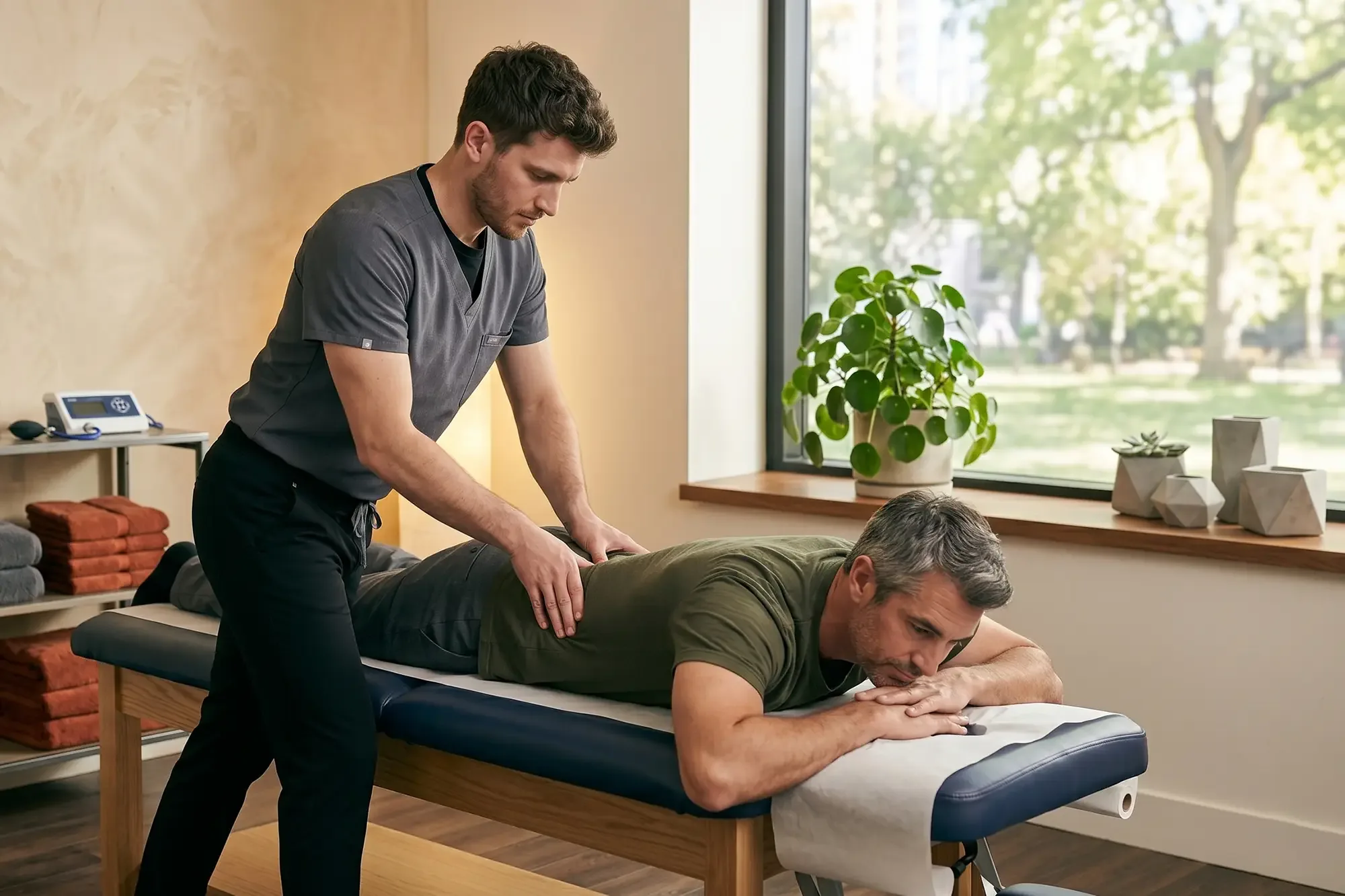
Skilled hands on the joint and the tissue around it: mobilization, soft tissue work, and the graded stretch that gets a stiff segment moving again before you’re asked to load it. Manual therapy is what buys the room for the exercise to work. It is scheduled inside your plan rather than sold as a standing weekly hour, and it is paired with something you do yourself, because range you cannot control on your own tends not to stay.

Spinal Manipulation
A quick, specific thrust to a spinal segment that has stopped moving the way it should, delivered by a licensed physical therapist trained to screen for it first. Most people know it by the sound. What matters more is the screening that happens before it, and the strength work that follows it, so the segment holds. Our clinical lead carries a Primary Spine Practitioner certification from the University of Pittsburgh, which is the standard the rest of the spine care here is written to.
Vestibular Therapy
For the room that spins when you roll over in bed, and for the balance that has quietly stopped being automatic. Vestibular therapy tests the inner ear, the eyes and the way you steady yourself, then retrains the system that has drifted. It is unglamorous work and often surprisingly fast: repositioning for some people, weeks of graded balance and gaze training for others. Either way you leave the first visit knowing which one you are.

Nine techniques, used inside a plan.
Tools, not appointments. Your therapist reaches for one of these when the evaluation points there, and stops when it stops earning its place.
Dry Needling ⟶
A thin filament needle into the trigger point that has not loosened with movement or hands alone.
08Cupping ⟶
Suction that lifts tissue instead of pressing it, for the back that stays tight between visits.
09Active Release Technique ⟶
Pressure held while you move the limb, aimed at the scar tissue and adhesion inside a muscle.
10Astym ⟶
Instrument-assisted work over tendon and scar tissue, used to restart a stalled healing response.
11IASTM ⟶
Instrument-assisted soft tissue mobilization for restriction a hand cannot reach precisely enough.
12Blood Flow Restriction ⟶
A calibrated cuff so light loads build strength, useful when a joint cannot take heavy loads yet.
13Laser Therapy ⟶
Targeted light over an irritated tendon or joint, used to calm symptoms during the Pain phase.
14Ultrasound ⟶
Sound waves into deeper tissue, chosen when the area is too irritable for hands-on work.
15Cryotherapy ⟶
Cold applied on purpose and on schedule, for the flare that needs settling before the next session.
Not sure which one is yours.
Here’s the honest version: you don’t need to know. People who read a services page before booking anything aren’t being fussy. They’re trying to stop guessing and start somewhere, and that instinct is sound. It’s also exactly what the evaluation is for.
A rough starting point, if you want one. Pain that’s new, or that’s nagged for a few weeks, usually starts with physical therapy. A joint problem, a post-op knee, or a shoulder that won’t settle starts with orthopedic therapy. Getting back to a sport starts with sports rehab. Stiffness that hasn’t budged with exercise alone is a manual therapy or spinal manipulation conversation. A room that spins when you roll over in bed is vestibular therapy. Everything after that, dry needling through cryotherapy, is a technique your therapist adds inside whichever of those plans you’re on. Treat all of it as a guess, not a diagnosis, the same way we would.
If you already know your symptom better than the service you need, start on What We Treat ⟶ instead and work backward from there.
“King’s Physical Therapy is an awesome place to heal and get better. They push you to extreme and they know your limits. The staff is very personable and you feel like family while you are there. Highly recommend them for all your therapy needs.”William B. · Patient review
Put it in writing.
Six short questions. A real person calls you back, usually within two business hours, with times that fit your week.
The people who end up filling this out are rarely in the worst pain of their life. They’re just done working around it, done picking the errand that doesn’t require the stairs. If that’s the stage you’re at, this is the part where you stop researching and start.
Consider it filed.
A real person will call you back, usually within two business hours, with appointment times that fit your week. Keep your phone nearby.
Can’t wait? Call (724) 628-7288 ⟶Two clinics. Same standard in both.
Connellsville and Scottdale, both fully staffed, both easy to park at. Come see either one before you commit, if you like.
Clinic 01 · Connellsville
Directions to Connellsville ⟶ (opens in a new tab)
Clinic 02 · Scottdale
Directions to Scottdale ⟶ (opens in a new tab)