

Connellsville, PA · What we treat
Elbow, wrist, and hand pain in Connellsville.
A grip that gives out, or a forearm that has stopped forgiving repetition: a cause-first evaluation finds out why yours is doing this, then a plan with an endpoint gets you opening jars, typing past an hour, and carrying the groceries in one trip again.

You’ve probably said one of these.
Nobody walks in describing lateral epicondylalgia. They describe weeks like these. Tap one that sounds like yours.
-
UsuallyTennis elbow, or a grip that has quietly backed off to protect an irritated tendon before you consciously decided anything.
Why does this happen ⟶ -
OftenNerve irritation at the wrist, sometimes carpal tunnel, provoked by a fixed position held longer than the tissue tolerates.
Why does this happen ⟶ -
UsuallyThumb or finger tendon irritation, or stiffness left over from an injury the hand never fully got back from.
Why does this happen ⟶
- “My grip gives out on a full coffee mug about once a week now.”
- “I shake hands left-handed, and I keep a joke ready to cover it.”
- “Wringing out a towel is the chore I quietly handed off months ago.”
If two or three of those sound like your week, you’re not describing a mystery. You’re describing a pattern we see often, and one an evaluation is built to explain.
If you’ve been redistributing chores rather than complaining about a forearm, that isn’t toughness. That’s a tendon that has been quietly setting the terms of your week for longer than you’d admit out loud.
Why do elbow, wrist, and hand pain happen?
There’s rarely one single cause, which is exactly why guessing doesn’t work. What we usually find, alone or in combination:
- Tennis elbow. Irritation where the tendons attach on the outside of the elbow, usually built by repetitive gripping or wrist extension, racquet sport or otherwise.
- Golfer’s elbow. The same story on the inside of the elbow, usually from repeated gripping or wrist flexion under load, and just as common in people who have never held a club.
- Carpal tunnel or nerve irritation at the wrist. Pressure on the nerve running through the wrist, often worse with typing, with a steering wheel, or with sleeping on a bent wrist all night.
- Thumb and wrist tendinopathy. Overloaded tendons crossing the wrist and the base of the thumb, common after a new job, a new baby, or a new hobby the tissue was never conditioned for.
- Stiffness after a fracture, a cast, or surgery. Range and grip that never came all the way back, and that stopped improving once formal recovery ended.
None of these are diagnoses you make yourself, and most don’t require imaging to start treating. That’s what the evaluation sorts out, and if anything looks like it needs a physician first, we’ll say so and point you there.
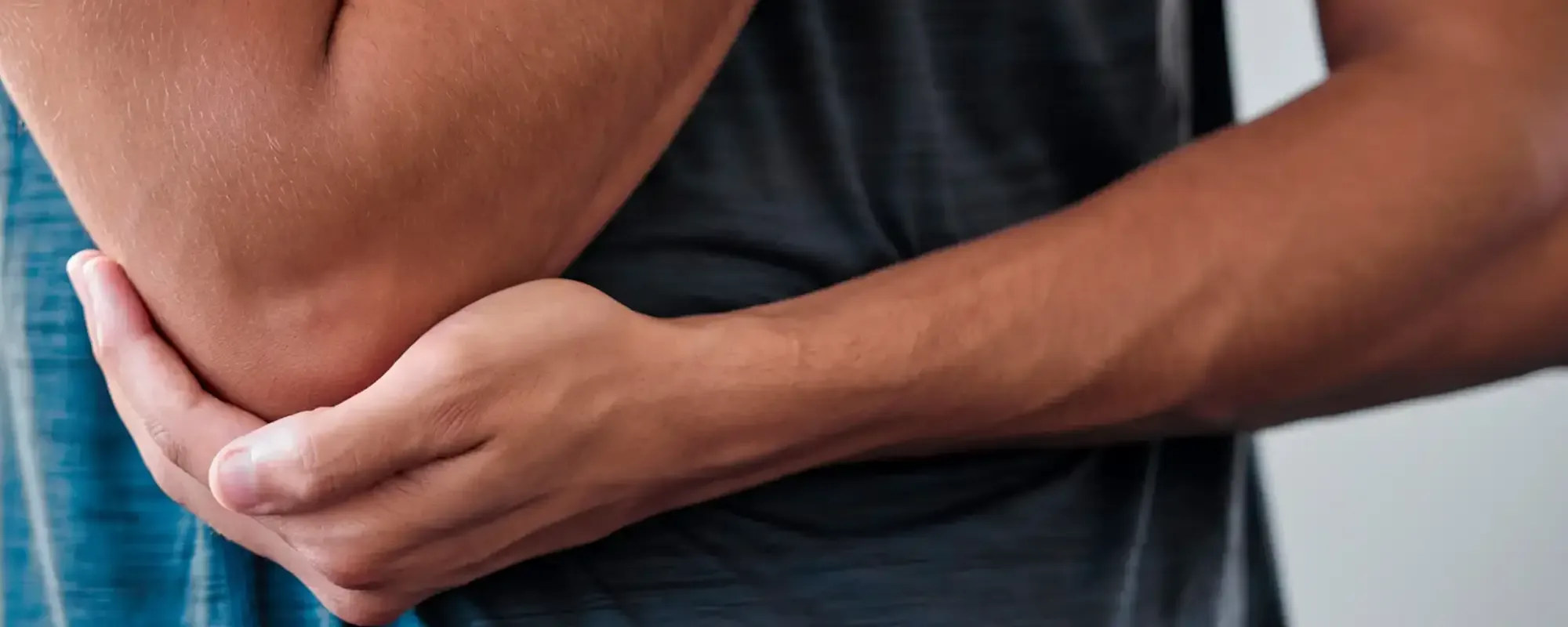
How do we treat elbow, wrist, and hand pain in Connellsville?
Treatment starts with a cause-first evaluation: testing grip, forearm rotation, wrist and finger motion, and the nerve provocation tests that separate a tendon problem from a nerve problem, because the two get treated differently and can feel much the same. We test, not guess. From there, care moves through four named phases.
You work one-on-one with a licensed physical therapist, every visit. Pennsylvania allows direct access, so no referral is needed to start, and the initial evaluation runs about 90 minutes so there’s time to do the testing properly.
The plan’s endpoint is named at your evaluation, reviewed with you every phase, because the goal is to get you back to your week, not to keep you on the schedule.
Calm it down.
Hands-on manual therapy, plus bracing or activity guidance that unloads the irritated tendon or nerve, starting the first visit. Most patients notice a meaningful difference within the first few sessions.
Restore what’s stuck.
Mobility work for the wrist, forearm, and fingers actually limiting you, dosed to what the tissue can tolerate that week, not a printed sheet handed to everyone.
Build strength you trust.
Progressive grip and forearm strength against standards you clear before moving on, so gripping, twisting, and lifting become load-tolerant again, not just briefly pain-free.
Make it stay fixed.
Testing before you’re cleared, then a home program sized to your job, your desk, or your sport, plus coaching on the wrist positions and grip habits that reload the same tendon.
What does getting better look like?
People who end up booking an evaluation for elbow, wrist, or hand pain are rarely the ones who hurt it in a single dramatic swing. More often it’s a slower story: months of asking for help with jars, of angling a handshake, of deciding a sore forearm is simply what happens after forty. If that’s closer to your version, you’re the typical patient here, not an outlier.
Most patients notice a difference within the first two or three visits, since treatment starts at the evaluation itself rather than after a week of paperwork. From there, progress tends to show up in ordinary places first: a jar opened without an audience, an hour of typing that ends quietly, a mug carried across a room without the second thought that used to come with it.
Left alone, an irritated tendon rarely stays put; the grip goes on backing off to protect it, the other arm takes over more of the week, and by the time anyone calls, there are two problems to unwind instead of one.
An evaluation turns that guesswork into a plan with an endpoint, named at the start and reviewed with you at every phase. Not an open-ended schedule, and not a promise made before anyone has looked at you.
Which services treat elbow, wrist, and hand pain?
Physical Therapy
Is the foundation of treatment: the cause-first evaluation and the four-phase plan that runs the whole recovery.
02Dry Needling
Targets the forearm trigger points feeding tennis elbow and golfer’s elbow when they aren’t releasing with manual therapy alone.
03ASTYM
An instrument-assisted technique for tendon tissue that has stopped remodeling on its own, a common sticking point at the elbow.
04Active Release Technique
A movement-based soft tissue technique, used when a nerve or tendon is being crowded by the tissue around it rather than injured itself.
“Kings has been a great place for myself or anyone that needs to receive physical therapy. My physical results have been improved and the staff and therapist are a pleasure to work with.”Joseph K. · Patient review
Questions, answered plainly.
The things people ask on the phone about their elbow, wrist, and hand, written down.
It could be any of the three, and from the inside they can feel alike: tennis elbow usually sits on the outside of the elbow, golfer’s elbow on the inside, and carpal tunnel tends to arrive as numbness or tingling in the fingers alongside wrist pain. The evaluation tests grip, movement, and nerve provocation to sort out which pattern, or which combination, actually fits what you have.
No. Pennsylvania allows direct access, so no referral is needed to be evaluated here. You work one-on-one with a licensed physical therapist, every visit, and the initial evaluation runs about 90 minutes, which is enough time to test grip and nerve provocation properly rather than press on the sore spot and send you home.
A brace can ease symptoms for a while by taking load off the irritated tendon or nerve, but it rarely addresses why the tissue got overloaded in the first place. Most people who rely on a brace alone find the pain returns the moment it comes off and the old grip pattern comes back. An evaluation identifies the cause, so the brace supports the plan instead of standing in for it.
Avoid pushing through a sharp pain while gripping or twisting, repetitive motions held far past the point they started to complain, and sudden heavy lifting before you have been cleared. Beyond that, avoidance is rarely the fix: most people do better learning which grips are safe to load than by resting completely and waiting. Your evaluation will tell you exactly what to modify and for how long.
Start with a cause-first evaluation for your elbow, wrist, and hand.
Put it in writing.
Six short questions. A real person calls you back, usually within two business hours, with times that fit your week.
The people who end up filling this out are rarely in the worst pain of their life. They’re just done working around it, done picking the errand that doesn’t require the stairs. If that’s the stage you’re at, this is the part where you stop researching and start.
Consider it filed.
A real person will call you back, usually within two business hours, with appointment times that fit your week. Keep your phone nearby.
Can’t wait? Call (724) 628-7288 ⟶Two clinics. Same standard in both.
Connellsville and Scottdale, both fully staffed, both easy to park at. Come see either one before you commit, if you like.
Clinic 01 · Connellsville
Directions to Connellsville ⟶ (opens in a new tab)
Clinic 02 · Scottdale
Directions to Scottdale ⟶ (opens in a new tab)