

Connellsville, PA · Services
Sports rehab in Connellsville.
Return-to-sport testing you have to pass, not a date circled on a calendar: one-on-one with a licensed physical therapist, a cause-first evaluation, and standards written from what your sport actually asks of you.

What is sports rehab in Connellsville?
Sports rehab starts where general physical therapy does: a cause-first evaluation that tests movement, strength and the joints above and below the one that got benched, not only the spot that is loud. What changes is the finish line. A weekend runner rebuilding a hamstring and a varsity pitcher rebuilding a shoulder need different things proven before either one goes back, so the standards are written from the sport rather than borrowed from a generic timeline.
Care still runs through the same four named phases, Pain, Prime, Perform and Prevent, in that order. Sports rehab simply leans hardest on the back half. Perform is where load and speed build against numbers you have to hit. Prevent is where you get tested against your sport’s actual movements, tired, before anyone uses the word cleared. Every visit is one-on-one with a licensed physical therapist, not a rotating trainer running a group through a circuit.
Clearance here means passing tests. Hop distance compared side to side, strength ratios, landing mechanics, change of direction, whatever the injured joint has to survive on a Friday night. You are told those standards at your evaluation, so you always know what you are working toward. If the numbers say not yet, it is not yet, and you get told why in plain language.
Calm it down.
Hands-on treatment begins at the first visit. You leave understanding what’s actually going on, and you feel a difference early.
Restore what’s stuck.
Targeted mobility work for the joints and tissue actually holding you back, dosed to your body, not a printed sheet.
Build strength you trust.
Progressive load against standards you have to clear before moving on. Confidence, here, is a training effect.
Make it stay fixed.
Testing before you’re cleared, then a keep-it-gone program sized to your real week. Then we graduate you.
What injuries does sports rehab treat?
Sports rehab picks up where the injury happened during activity, training or competition, though you do not need to be a competitive athlete for it to be the right room. A sample of what it commonly addresses:
Sports injuries ⟶
The sprain, strain or tear that ended a season early and still has something to prove.
02Hip & knee pain ⟶
Ligament recovery, the runner’s knee that votes against every squat, and the hip that makes cutting a gamble.
03Shoulder pain ⟶
The throwing shoulder and the rotator cuff that speaks up the moment you reach back for the fence.
04Foot or ankle pain ⟶
The rolled ankle that never quite finished healing, and the Achilles that tightens before every practice.
05Back pain & sciatica ⟶
The back that tightens by the third set and turns a lifting session into a negotiation.
06Pre & post surgery ⟶
The long rebuild after a repair, where the testing at the end is what decides how it holds.
Going back without passing the actual tests tends to end the same way: the same joint, hurt again, usually further from the season than the first time. A body cleared by the calendar instead of by the numbers walks onto the field still carrying the thing that caused the injury, and the field has no interest in how many weeks have gone by.
What does a sports rehab session look like?
Early sessions look close to standard physical therapy: hands-on manual work, targeted mobility, and loading dosed to where the tissue actually is rather than where you would like it to be. Your evaluation, about ninety minutes, sets the standards you are working toward and writes them down. Every visit after that checks progress against them.
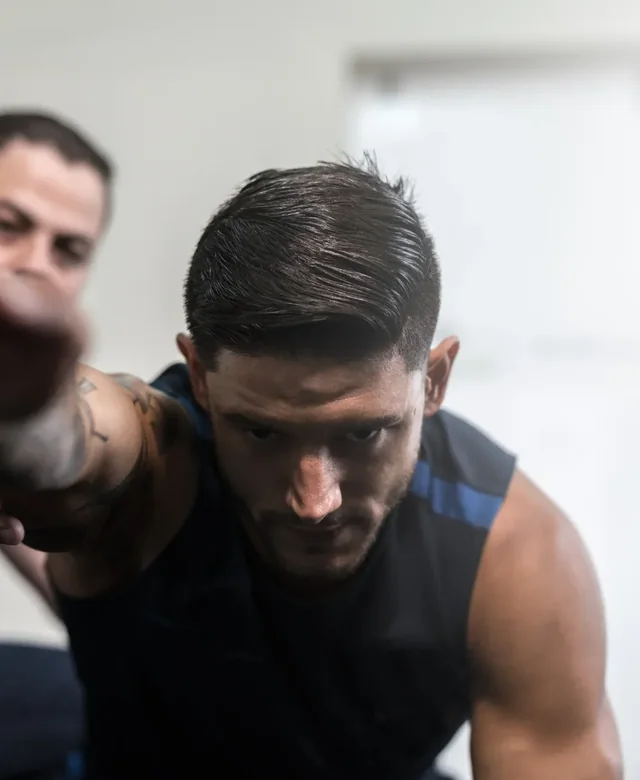
Later sessions look more like practice than a clinic visit. Agility work, cutting and landing mechanics, sport-specific strength, and testing run under the kind of fatigue a real game produces, because a joint that holds up fresh and fails tired has not actually passed. Your licensed physical therapist runs the session and calls the standards. Nothing gets waved through because the calendar says it is time.
Who sports rehab is for, and who it isn’t.
Sports rehab fits athletes at any level: weekend league, high school, varsity, the former college player whose knee still does not feel right, the adult who started running again in April and paid for it in May. It also fits an old injury that never got the return-to-play testing it needed the first time, which is a surprisingly common story and a fixable one. No referral is needed to start, and you do not need to already know the diagnosis.
If you would rather pass a test than trust a guess, and the thought of getting hurt the same way twice is what actually brought you to this page, you are the right athlete for this room. That instinct is not caution. It is how people finish seasons.
It is not the right first stop for an acute injury that needs imaging or a physician’s exam first: a suspected fracture, a joint that will not bear weight at all, or significant swelling inside the first hour. It is also not the place for return-to-play clearance after a concussion, which follows its own protocol with its own providers. See your physician first in both cases, then come to us for the rehabilitation and the testing that follows.
Good fit
- An injury that happened during activity, training or competition
- An old injury that never got proper return-to-play testing
- Athletes at any level, from weekend league to varsity to former college
- No referral required, and no need to already know the diagnosis
Not the right fit
- An acute injury needing imaging first: suspected fracture, a joint that won’t bear weight, immediate significant swelling
- Return-to-play clearance after a concussion, which follows its own protocol
- Anyone who wants a clearance date rather than a clearance test
Physical therapy ⟶
The cause-first evaluation and the four-phase plan the standards are built on top of.
02Blood flow restriction ⟶
For building strength at light loads while a healing joint still can’t take heavy ones.
03Dry needling ⟶
For the muscle that keeps guarding and holding a drill back from being done properly.
04Manual therapy ⟶
Hands-on work for the range a sport needs and the joint is not giving up yet.
Sports rehab sets the standard. The tools above exist to get you over it. See the full list of services.
“King’s Physical Therapy is an awesome place to heal and get better. They push you to extreme and they know your limits. The staff is very personable and you feel like family while you are there. Highly recommend them for all your therapy needs.”William B. · Patient review
Questions, answered plainly.
Both start with the same cause-first evaluation and the same one-on-one care with a licensed physical therapist. Sports rehab adds return-to-sport standards built around what your sport actually demands, cutting, throwing, sprinting, landing, and it leans harder on the Perform and Prevent phases, where you are tested under load and under fatigue before anyone calls you cleared.
No. Sports rehab tends to fit anyone hurt while moving: a weekend pickup game, a recreational league, a training block, a first attempt at running again after years off. What matters is that the injury happened during activity and that you want to get back to that activity, not your level of competition.
By testing rather than by the calendar. Strength compared side to side, hop and landing tests, and movement screens run under the kind of fatigue your sport actually produces. Your standards are set at your evaluation so you know them from the start. If a standard is not met, we keep working on it instead of clearing you and hoping.
Wear clothes and shoes you can move and cut in, bring your insurance card if you have one, and be ready to describe your sport, your position and where you are in the season, since the standards you get tested against are built from what that sport asks of you. Imaging helps if you already have it, but you do not need it to start.
Start with the evaluation that sets your standards.
Put it in writing.
Six short questions. A real person calls you back, usually within two business hours, with times that fit your week.
The people who end up filling this out are rarely in the worst pain of their life. They’re just done working around it, done picking the errand that doesn’t require the stairs. If that’s the stage you’re at, this is the part where you stop researching and start.
Consider it filed.
A real person will call you back, usually within two business hours, with appointment times that fit your week. Keep your phone nearby.
Can’t wait? Call (724) 628-7288 ⟶Two clinics. Same standard in both.
Connellsville and Scottdale, both fully staffed, both easy to park at. Come see either one before you commit, if you like.
Clinic 01 · Connellsville
Directions to Connellsville ⟶ (opens in a new tab)
Clinic 02 · Scottdale
Directions to Scottdale ⟶ (opens in a new tab)