Request an appointment
No referral needed. A real person calls you back, usually within two business hours.
Connellsville, PA · Services
IASTM in Connellsville.
Instrument-assisted soft tissue mobilization for tissue that has gone stiff, ropey, or guarded: one tool inside a cause-first plan with a licensed physical therapist, never an appointment you book on its own.

What is IASTM in Connellsville?
IASTM stands for instrument-assisted soft tissue mobilization. Your licensed physical therapist uses a hard-edged instrument, usually stainless steel and shaped to sit against the contour of the area being treated, and draws it across the skin over tissue that has stopped gliding the way it should. The edge does two jobs at once. It lets the therapist feel texture through the tool that fingertips alone can miss, and it concentrates pressure into a restricted band of fascia, scar, or muscle more precisely than a thumb can.
The instrument is only half of it. Treated tissue gets loaded immediately afterward, in the same visit, with the mobility and strength work that teaches the area to use its new range. Working tissue that then goes back to sitting still is a short-lived result. That pairing is the entire point, and it is why IASTM is never booked here as a standalone appointment. It sits inside a cause-first evaluation and a plan that runs the four named phases: Pain, Prime, Perform, and Prevent. It earns its keep mostly in Prime, when something is stuck and the loading work cannot get traction until it releases.
IASTM is a cousin of Astym, not a synonym for it. Astym is a specific branded system with its own instruments and its own protocol, and it has its own page here. IASTM is the broader technique. If you have had one, ask about the other at your evaluation. Your licensed physical therapist will tell you which one, if either, belongs in your plan at all.
Calm it down.
Hands-on treatment begins at the first visit. You leave understanding what’s actually going on, and you feel a difference early.
Restore what’s stuck.
Targeted mobility work for the joints and tissue actually holding you back, dosed to your body, not a printed sheet.
Build strength you trust.
Progressive load against standards you have to clear before moving on. Confidence, here, is a training effect.
Make it stay fixed.
Testing before you’re cleared, then a keep-it-gone program sized to your real week. Then we graduate you.
What conditions does IASTM treat?
IASTM tends to get called in when the evaluation finds tissue that has lost its glide: an old scar, a thickened tendon, a band of fascia that will not let the joint underneath it travel. A sample of what it commonly supports:
Elbow, wrist & hand pain ⟶
The thickened forearm tendon that flares every time you grip a jar lid or a steering wheel.
02Shoulder pain ⟶
The guarded reach, where the tissue around the joint has stopped sliding and the range stops short.
03Foot or ankle pain ⟶
The ropey heel cord or the tender arch that makes the first ten steps on a Tuesday the worst ten of the day.
04Pre and post surgery ⟶
Scar tissue laid down after a repair, worked so the skin and the layers beneath it move together again.
Left alone, tissue that has stopped gliding rarely stays a local problem. The joint underneath it travels less, the muscle above it works harder to cover the difference, and a few months later the thing that hurts is no longer the thing that started it. The instrument work is the quick part. Finding what caused the restriction is the part that takes an evaluation.
What does an IASTM session look like?
IASTM happens during a normal visit, not on a separate calendar. Your licensed physical therapist puts a light emollient on the skin, then works the instrument over the target area in short, deliberate passes, changing angle and pressure based on what the tool reports back. One area usually takes a few minutes. You feel a firm scraping sensation and, over the spots that are genuinely restricted, a gritty catch that eases as the pass is repeated.
Temporary redness in the treated area is normal and expected. It generally shows up within minutes, looks worse than it feels, and fades over a few hours to a day. Some patients get mild bruising, or next-day soreness like the morning after a hard workout. Your therapist adjusts pressure to keep it in that range, which only works if you say what you are feeling instead of gritting through it.
The rest of the visit is the part that makes it stick: mobility work through the range you just got back, then loading it. IASTM opens a door. The exercise is what walks through it, and the two are scheduled together for exactly that reason.
Who IASTM is for, and who it isn’t.
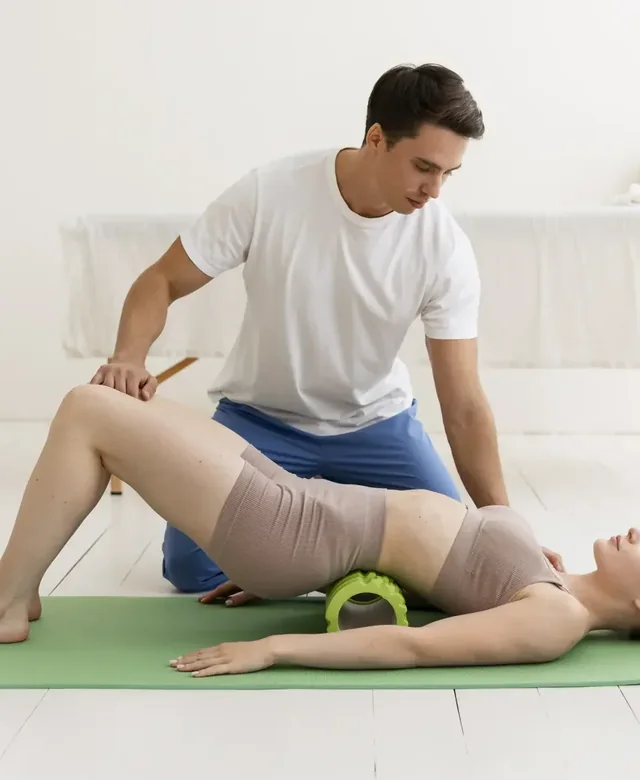
IASTM tends to fit patients whose evaluation turns up a specific, palpable restriction: the scar that puckers, the tendon that feels thicker than its twin on the other side, the band of tissue that stops a joint short of where it should go. It is most useful as an accelerant inside a plan already underway, and least useful as the first thing anyone reaches for.
If you came looking for IASTM by name, you have probably already stretched it, rolled it, and waited it out, and you would like someone to work the actual spot. That instinct is sound. Bring it to the evaluation as a question rather than an instruction, because the honest answer is sometimes that the restriction you can feel is not the reason you hurt.
It is not for everyone, and your therapist screens before the instrument comes out. Broken or infected skin over the target area, an active rash or burn, unhealed fractures, unexplained swelling, and certain bleeding disorders all either rule it out or change the approach. If you take a medication that thins your blood, or you bruise easily, say so at the evaluation rather than after the first treatment.
Good fit
- A specific, palpable restriction the evaluation can find and point to
- Tissue that hasn’t responded to stretching, rolling, or hands-on work alone
- Willing to do the loading work in the same visit that makes the release hold
- Comfortable with temporary redness, and sometimes mild bruising, in the treated area
Not the right fit
- Broken, infected, or burned skin over the area to be treated
- Certain bleeding disorders, or blood thinners, without clearance (screened at evaluation)
- An unhealed fracture or unexplained swelling in the region
- Anyone hoping to book it on its own instead of doing the rest of the plan
What IASTM works alongside.
It is one tool on a bench that holds several. These are the ones it most often sits beside, and the pages worth reading before you decide anything.
Astym ⟶
The branded system IASTM is often confused with. Different instruments, different protocol, same question at the evaluation.
02Manual Therapy ⟶
The hands-on work that comes before and after the instrument in most visits.
03Active Release Technique ⟶
Another way at restricted tissue, worked through movement rather than through a tool.
04Physical Therapy ⟶
The evaluation and the plan the instrument is there to serve.
“Kings has been a great place for myself or anyone that needs to receive physical therapy. My physical results have been improved and the staff and therapist are a pleasure to work with.”Joseph K. · Patient review
IASTM questions, answered plainly.
It is firm, but it should not be sharp. Most patients describe a scraping pressure, with a gritty catch over the spots that are genuinely restricted, and that catch eases as the area is worked. Your licensed physical therapist adjusts pressure to what you report, so speak up during the pass rather than after it. Mild soreness the next day, similar to a hard workout, is common.
Temporary redness in the treated area is normal and expected. It usually appears within minutes, looks worse than it feels, and fades over a few hours to a day. Some patients also get mild bruising. If the redness or bruising is worse than your therapist described, say so before the next session so the pressure can be dialed back.
No. Astym is a specific branded system with its own instruments and its own protocol, and it has its own page on this site. IASTM is the broader family of instrument-assisted soft tissue work. They overlap, they are not interchangeable, and your licensed physical therapist will tell you at your evaluation which one, if either, fits your plan at all.
Here, no. IASTM is scheduled inside an existing physical therapy plan, after a cause-first evaluation confirms there is a restriction worth treating this way. The instrument work is paired in the same visit with the mobility and strength work that makes the change hold. On its own it is a short-lived result, which is not what you came in for.
Start with the evaluation that finds the restriction.
Put it in writing.
Six short questions. A real person calls you back, usually within two business hours, with times that fit your week.
The people who end up filling this out are rarely in the worst pain of their life. They’re just done working around it, done picking the errand that doesn’t require the stairs. If that’s the stage you’re at, this is the part where you stop researching and start.
Consider it filed.
A real person will call you back, usually within two business hours, with appointment times that fit your week. Keep your phone nearby.
Can’t wait? Call (724) 628-7288 ⟶Two clinics. Same standard in both.
Connellsville and Scottdale, both fully staffed, both easy to park at. Come see either one before you commit, if you like.
Clinic 01 · Connellsville
Directions to Connellsville ⟶ (opens in a new tab)
Clinic 02 · Scottdale
Directions to Scottdale ⟶ (opens in a new tab)