

Connellsville, PA · Services
Orthopedic therapy in Connellsville.
Joints, tendons and the mechanics that connect them, measured joint by joint at a cause-first evaluation and treated one-on-one by a licensed physical therapist. Dr. Jarrod King is a board-certified orthopaedic clinical specialist.

What is orthopedic therapy in Connellsville?
Orthopedic therapy is physical therapy aimed at the musculoskeletal system: joints, tendons, ligaments, muscle, and the mechanics that hold the whole arrangement together. It is the shoulder that will not go overhead any more. The knee that has opinions about stairs. The tendon that has been sore since March and has not improved on rest. The joint that was recently repaired and now has to be rebuilt into something you trust again.
The distinguishing work is the evaluation, and it is deliberately wider than the sore spot. Your therapist measures range at the painful joint, then at the joints above and below it, and tests strength side to side so there is a number rather than an impression. A shoulder often hurts for a reason that begins in the mid back. A knee often hurts for a reason that begins at the hip. We test, not guess, and what the testing finds is what the plan treats.
Two credentials, stated plainly and without embroidery: Dr. Jarrod King is a board-certified orthopaedic clinical specialist, earned in 2017, and a certified primary spine practitioner through the University of Pittsburgh, earned in 2019. Care still runs one-on-one with a licensed physical therapist, every visit, through the same four named phases: Pain, Prime, Perform and Prevent, in that order.
Calm it down.
Hands-on treatment begins at the first visit. You leave understanding what’s actually going on, and you feel a difference early.
Restore what’s stuck.
Targeted mobility work for the joints and tissue actually holding you back, dosed to your body, not a printed sheet.
Build strength you trust.
Progressive load against standards you have to clear before moving on. Confidence, here, is a training effect.
Make it stay fixed.
Testing before you’re cleared, then a keep-it-gone program sized to your real week. Then we graduate you.
What conditions does orthopedic therapy treat?
If the story behind your pain is mechanical, a sprain, a strain, a stiff joint, an angry tendon, or a repair that has to be rebuilt around, this is the page for it. A sample of what it commonly addresses:
Shoulder pain ⟶
Rotator cuff irritation and the shoulder that stalls halfway to the top shelf.
02Hip & knee pain ⟶
The knee that argues on stairs and the hip that has started deciding how far you walk.
03Elbow, wrist & hand pain ⟶
Tendon pain at the elbow, and the grip that gives out halfway through a jar lid.
04Neck pain ⟶
The segment that stopped rotating, and the shoulder blade that has been covering for it.
05Back pain & sciatica ⟶
The stiff hinge at the bottom of the back and the leg symptoms that follow it around.
06Arthritis ⟶
A joint with wear on it that still has more range and more strength available than it is using.
07Pre & post surgery ⟶
The weeks before a repair or replacement, and the months afterward that decide how well it holds.
08Foot or ankle pain ⟶
The ankle that never got its motion back after the sprain, and the heel that runs the first ten steps of the day.
A joint that hurts gets protected, and protection is a habit the rest of the body picks up quickly. Left alone, the limp that saves a knee starts taxing the hip. The shoulder that stops going overhead loses the range it will need later. By the time anyone calls, the compensation has usually become its own appointment, sitting on top of the original one.
What does an orthopedic therapy session look like?
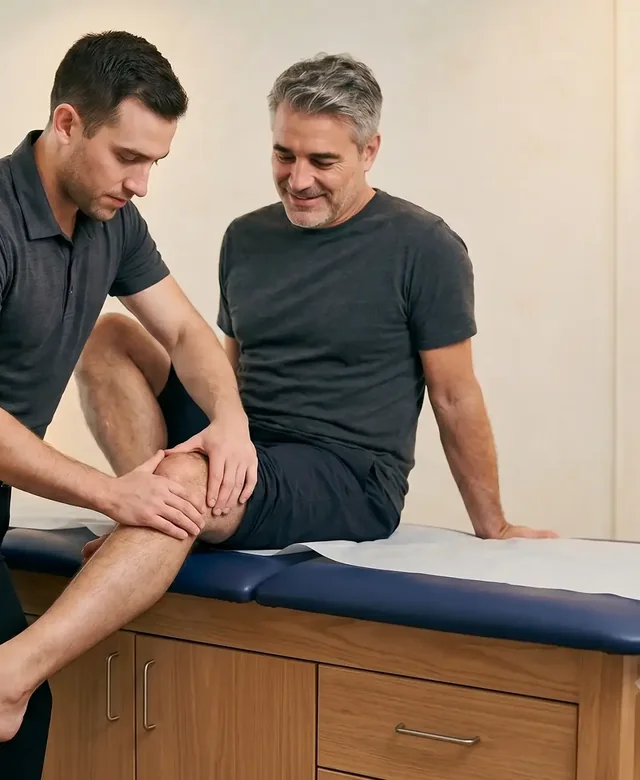
The first visit is the evaluation and runs about ninety minutes. Your therapist measures range of motion joint by joint, tests strength on both sides so there is a comparison rather than a guess, watches you perform the specific movement that hurts, and screens the joints above and below it. Hands-on treatment starts in that same visit, so you leave with a reading on what is actually happening and something already done about it.
Follow-ups typically run an hour: manual therapy where the evaluation pointed, then loading and movement work dosed to the phase you are in. The measurements taken at the evaluation get retaken, which is the part that matters. Progress here is a number that moved, not an impression that things feel a bit better, and those numbers are what decide when you advance a phase.
Who orthopedic therapy is for, and who it isn’t.
Orthopedic therapy fits a joint, tendon or muscle problem with a mechanical story behind it. A sprain or a strain that has not resolved on its own. Tendon pain that rest kept quiet and activity brought straight back. A joint that stiffened after an injury and never got its range returned. Arthritis that has more available motion in it than it is currently using. And the rehabilitation that follows an orthopedic surgery, which is where most of the long-term result is actually decided. No referral is needed to book the evaluation.
If you have already been told to rest it, and months later it is still there, wanting an actual mechanical explanation is not being a difficult patient. It is the correct question, and it happens to be the exact question a joint-by-joint evaluation is built to answer.
It is not the right first stop for a suspected fracture or dislocation, a joint that will not bear weight at all, signs of infection such as heat, redness and fever, or a symptom pattern that has red flags attached to it. Those belong to a physician first. See them, get the imaging or the exam that is needed, and then come to us for the rehabilitation, which is the part we are actually good at.
Good fit
- A sprain, strain or tendon problem that hasn’t resolved on rest
- A joint that stiffened after an injury and never got its range back
- Arthritis with more range and strength available than it’s using
- Rehabilitation before or after an orthopedic surgery
Not the right fit
- A suspected fracture or dislocation, or a joint that won’t bear weight at all
- Signs of infection in a joint: heat, redness, fever
- A red-flag symptom pattern that belongs to a physician first
Physical therapy ⟶
The cause-first evaluation and the four-phase plan this sits inside.
02Manual therapy ⟶
Hands-on joint and soft tissue work for the range the measurements say is missing.
03Spinal manipulation ⟶
For a spinal segment that screening says is restricted and safe to treat this way.
04Sports rehab ⟶
When the joint has to go back to a sport and not just to a normal week.
Orthopedic therapy names the mechanical problem. The tools above are chosen because your measurements pointed at them. See the full list of services.
“Best physical therapy facility! I’ve been to others over the years, but King’s worked wonders for me.”Bobbi R. · Patient review
Questions, answered plainly.
Orthopedic therapy is physical therapy aimed squarely at the musculoskeletal system: joints, tendons, ligaments and the mechanics that connect them. The one-on-one format, the cause-first evaluation and the four phases are the same. What changes is the emphasis, which sits on joint-by-joint testing, measured range and strength, and what the joints above and below the painful one are contributing to it.
No. Pennsylvania allows direct access to physical therapy, so you can book an evaluation without a prescription from a physician. If your insurance plan requires a referral for reimbursement, we will flag it during your free benefits check and help you get one before it delays your start.
Yes. Dr. Jarrod King is a board-certified orthopaedic clinical specialist, a credential he earned in 2017, and a certified primary spine practitioner through the University of Pittsburgh, earned in 2019. Whichever clinician you see, every visit is one-on-one with a licensed physical therapist for the full hour.
Yes, and both halves matter. Before an operation, the work is range and strength, because a joint that goes in stronger usually has an easier few months afterward. After it, we follow the protocol your surgeon sets and then build from there: range first, then strength, then the ordinary demands the joint has to meet again, tested rather than assumed.
Start with the evaluation that measures the joint.
Put it in writing.
Six short questions. A real person calls you back, usually within two business hours, with times that fit your week.
The people who end up filling this out are rarely in the worst pain of their life. They’re just done working around it, done picking the errand that doesn’t require the stairs. If that’s the stage you’re at, this is the part where you stop researching and start.
Consider it filed.
A real person will call you back, usually within two business hours, with appointment times that fit your week. Keep your phone nearby.
Can’t wait? Call (724) 628-7288 ⟶Two clinics. Same standard in both.
Connellsville and Scottdale, both fully staffed, both easy to park at. Come see either one before you commit, if you like.
Clinic 01 · Connellsville
Directions to Connellsville ⟶ (opens in a new tab)
Clinic 02 · Scottdale
Directions to Scottdale ⟶ (opens in a new tab)