
Request an appointment
No referral needed. A real person calls you back, usually within two business hours.
Connellsville, PA · Services
Active Release Technique in Connellsville.
A certified hands-on protocol that treats one specific structure while you move it: precise pressure plus your own motion, used inside a cause-first plan with a licensed physical therapist.

What is Active Release Technique in Connellsville?
Active Release Technique is a trademarked, certified hands-on protocol with one distinguishing feature: you do half of it. Your therapist finds a specific structure, a named muscle, tendon, or the sheath a nerve travels through, holds precise tension on it, and then has you move the joint actively through a range while that tension stays put. The tissue is treated while it glides rather than while it sits still.
That combination is the point. Pressure alone treats a spot. Pressure held against a structure that is being lengthened under your own power treats the way that structure moves against everything around it, which is usually where a stubborn restriction actually lives. It is aimed at areas where tissue has thickened or lost its glide after an old injury, a long stretch of repetitive work, or years of the same posture at the same bench.
The protocol is specific and it is certified, which means the therapist using it has trained in the named treatment for the named structure rather than improvising. Here it is delivered one-on-one by a licensed physical therapist inside a cause-first plan that runs through the four named phases, Pain, Prime, Perform, and Prevent.
It is never a standalone appointment. Freeing a structure opens a window. The strength and movement work that follows in the same visit is what decides whether the window stays open.
Calm it down.
Hands-on treatment begins at the first visit. You leave understanding what’s actually going on, and you feel a difference early.
Restore what’s stuck.
Targeted mobility work for the joints and tissue actually holding you back, dosed to your body, not a printed sheet.
Build strength you trust.
Progressive load against standards you have to clear before moving on. Confidence, here, is a training effect.
Make it stay fixed.
Testing before you’re cleared, then a keep-it-gone program sized to your real week. Then we graduate you.
What conditions does Active Release Technique help with?
Active Release Technique gets used when the evaluation points at one structure that has lost its glide, usually after repetition rather than a single dramatic moment. A sample of what it commonly supports:
Elbow, wrist & hand pain ⟶
The forearm that aches by mid-afternoon and objects loudly to a jar lid or a screwdriver.
02Shoulder pain ⟶
Tissue around the cuff and the blade that catches in one narrow band of the reach and nowhere else.
03Hip & knee pain ⟶
The hip flexor, glute, or outer thigh that has stopped sliding cleanly and shortened your stride.
04Sports injuries ⟶
The old hamstring or calf that healed enough to run on and never quite stopped feeling stuck.
A structure that has lost its glide rarely announces itself. It just quietly costs you a little range, and you spend that range somewhere else: a shoulder that hikes, a hip that swings out, a wrist that borrows from the elbow. By the time the borrowed joint starts complaining, two things need treating instead of one.
What does an Active Release Technique session look like?
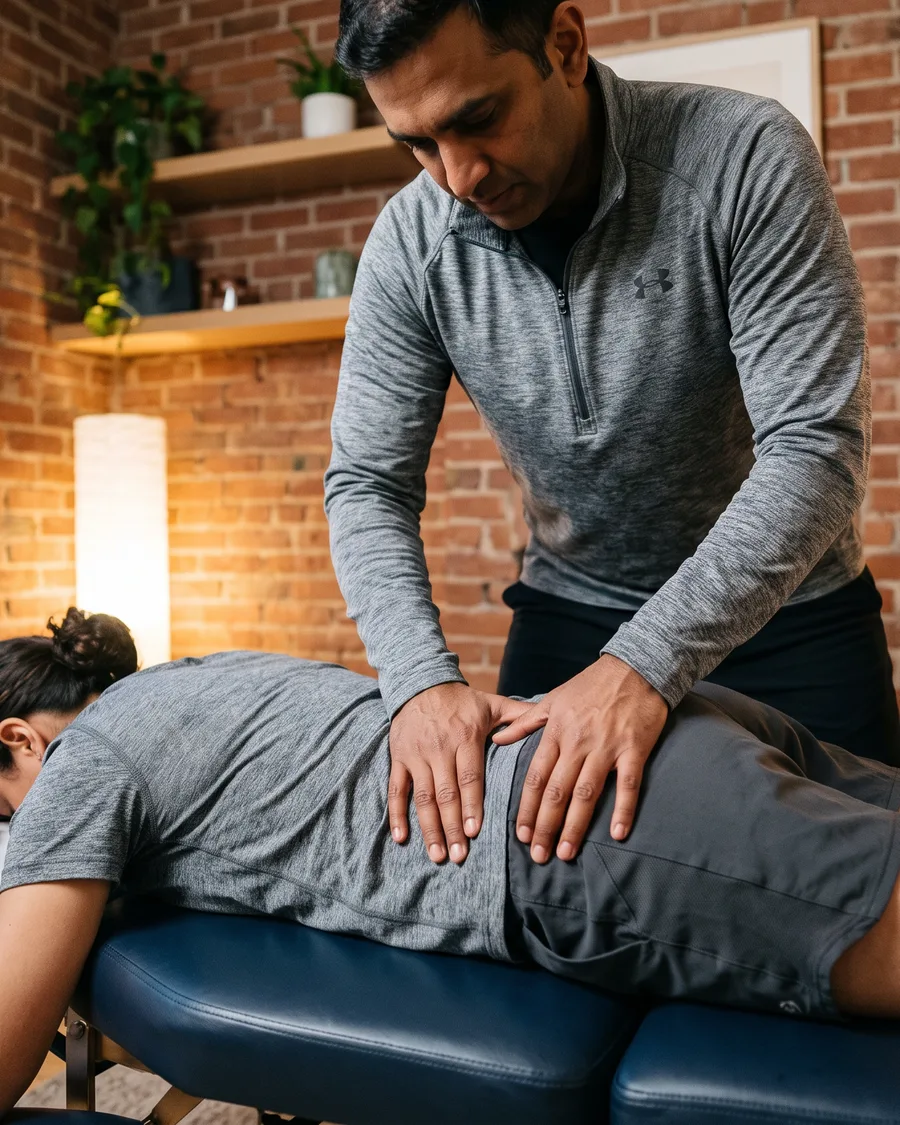
It happens inside a regular visit. Your licensed physical therapist tests the movement that hurts, narrows it down to a structure by hand, then sets up: contact on the tissue, tension held, and a clear instruction about which way to move and how fast. You move. The therapist holds. The pass takes a few seconds, and then you do it again.
Most patients describe firm pressure that becomes a distinct pulling as the limb travels. It can be uncomfortable in the way a deep stretch is uncomfortable. It should not be sharp, and your therapist asks between passes rather than after. Mild soreness for a day, similar to a hard session in the gym, is common.
Then the same movement gets retested, in front of you, so the question of whether anything changed is answered rather than assumed. If it did, the visit spends the new range immediately on loading. That order is deliberate: test, treat, retest, then load.
Who this is for, and who it isn’t.
Active Release Technique fits people whose problem lives in one place and shows up in one specific movement: the last few degrees of a reach, the turn of a wrist, the top of a stride. It fits repetitive-load histories especially well, the trade that uses the same tool eight hours a day, the sport that repeats the same arc a thousand times a season. And it fits people who would rather participate in a treatment than lie still through one.
If you have described your problem to somebody as one exact motion and been handed a general stretching sheet, your frustration is reasonable. Wanting the specific structure addressed specifically isn’t being difficult. It’s the correct instinct, and it is worth saying out loud at your evaluation.
It is not appropriate over an acute injury still in its first inflamed days, over open wounds, skin infection, or a fresh surgical site, and it is screened for bleeding disorders, blood thinners, and pregnancy considerations before anything is scheduled. It also asks something of you: if a joint cannot be moved actively through the range yet, the technique cannot be performed as designed, and something else comes first.
Good fit
- A restriction you can point to, in one specific movement
- Repetitive-load histories: the same tool, the same arc, the same bench
- Able and willing to move the joint actively during treatment
- Part of an existing physical therapy plan, with loading work in the same visit
Not the right fit
- An acute injury still in its first inflamed days
- Open wounds, skin infection, or a fresh surgical site
- Bleeding disorders, blood thinners, or pregnancy considerations, screened at evaluation
- A joint that cannot yet be moved actively through the range
Physical Therapy ⟶
The cause-first evaluation and the plan the protocol is used inside.
02Manual Therapy ⟶
Joint work for the stiffness above and below the structure being treated.
03Sports Rehab ⟶
Where the recovered range gets loaded until it holds up at speed.
Active Release Technique is one tool inside the plan, never a standalone appointment.
“Kings has been a great place for myself or anyone that needs to receive physical therapy. My physical results have been improved and the staff and therapist are a pleasure to work with.”Joseph K. · Patient review
Questions, answered plainly.
Most patients describe a firm, specific pressure that turns into a distinct pulling or stretching sensation the moment they start moving the limb. It can be uncomfortable in the way a deep stretch is uncomfortable, and it should not be sharp. Each pass lasts only a few seconds, your therapist checks in between passes, and mild soreness for a day afterward is common.
No. A massage works over a broad area with you lying still. Active Release Technique is a specific certified protocol in which the therapist holds tension on one named structure while you move the joint through a range, so the tissue is treated while it glides. The movement is the active half of the technique, and it is the reason it targets one structure rather than a region.
Not here. It is used inside a physical therapy plan, after a cause-first evaluation identifies which structure is restricted and why. Freeing a tissue is useful for a window of time. Whether the change holds depends on the strength and movement work that follows it in the same visit and over the following weeks.
It varies with how long the restriction has been there and how the tissue responds. Some areas change noticeably in two or three visits. Others need it repeated through the Pain and Prime phases while the loading work catches up. Your licensed physical therapist retests the same movement each visit, so you are not guessing about whether it is working.
Start with the evaluation that names the structure.
Put it in writing.
Six short questions. A real person calls you back, usually within two business hours, with times that fit your week.
The people who end up filling this out are rarely in the worst pain of their life. They’re just done working around it, done picking the errand that doesn’t require the stairs. If that’s the stage you’re at, this is the part where you stop researching and start.
Consider it filed.
A real person will call you back, usually within two business hours, with appointment times that fit your week. Keep your phone nearby.
Can’t wait? Call (724) 628-7288 ⟶Two clinics. Same standard in both.
Connellsville and Scottdale, both fully staffed, both easy to park at. Come see either one before you commit, if you like.
Clinic 01 · Connellsville
Directions to Connellsville ⟶ (opens in a new tab)
Clinic 02 · Scottdale
Directions to Scottdale ⟶ (opens in a new tab)