

Connellsville, PA · What we treat
Shoulder pain in Connellsville.
A shoulder that has stiffened up, or a lift that has started to catch: a cause-first evaluation finds out why yours is doing this, then a plan with an endpoint gets you reaching the top shelf, sleeping on that side, and lifting without the wince first.
You’ve probably said one of these.
Nobody walks in describing subacromial impingement. They describe weeks like these. Tap one that sounds like yours.
-
UsuallyRotator cuff irritation or impingement: strength that quietly backed off long before the pain ever got loud.
Why does this happen ⟶ -
OftenTendon irritation or early capsule stiffness, worse at night because the joint has nowhere neutral left to rest.
Why does this happen ⟶ -
UsuallyA mechanical pinch: tissue caught between the shoulder blade and the arm bone through one specific slice of the range.
Why does this happen ⟶
- “Putting on a jacket, I do the bad arm first now, or it doesn’t go on at all.”
- “Washing my hair, my arm gives out before my hair does.”
- “I moved the coffee down to the counter. The top shelf is somebody else’s job now.”
If two or three of those sound like your week, you’re not describing a mystery. You’re describing a pattern we see often, and one an evaluation is built to explain.
If you’ve been rearranging your kitchen around one arm rather than mentioning it to anyone, that isn’t stoicism. That’s a problem that has already been costing you something, quietly, for a while.
Why does shoulder pain happen?
There’s rarely one single cause, which is exactly why guessing doesn’t work. What we usually find, alone or in combination:
- Rotator cuff irritation or tendinopathy. The tendons that steer and steady the ball in the socket, irritated by repetitive overhead work or by strength that has slipped away without anyone noticing.
- Impingement. Tissue pinched between the top of the arm bone and the bone above it, usually through one specific arc of reaching or lifting rather than the whole range.
- Frozen shoulder. A joint capsule that has tightened and lost range, often for reasons that were never fully clear, and that tends to move through predictable stages.
- Labral irritation. The cartilage ring that deepens the socket, sometimes irritated by overhead sport, by heavy pressing, or by one specific incident you can name.
- After a repair or a replacement. Range and strength that stalled somewhere short of where they were supposed to land, whether the surgery was eight weeks ago or two years ago.
None of these are diagnoses you make yourself, and most don’t require imaging to start treating. That’s what the evaluation sorts out, and if anything looks like it needs a physician first, we’ll say so and point you there.

How do we treat shoulder pain in Connellsville?
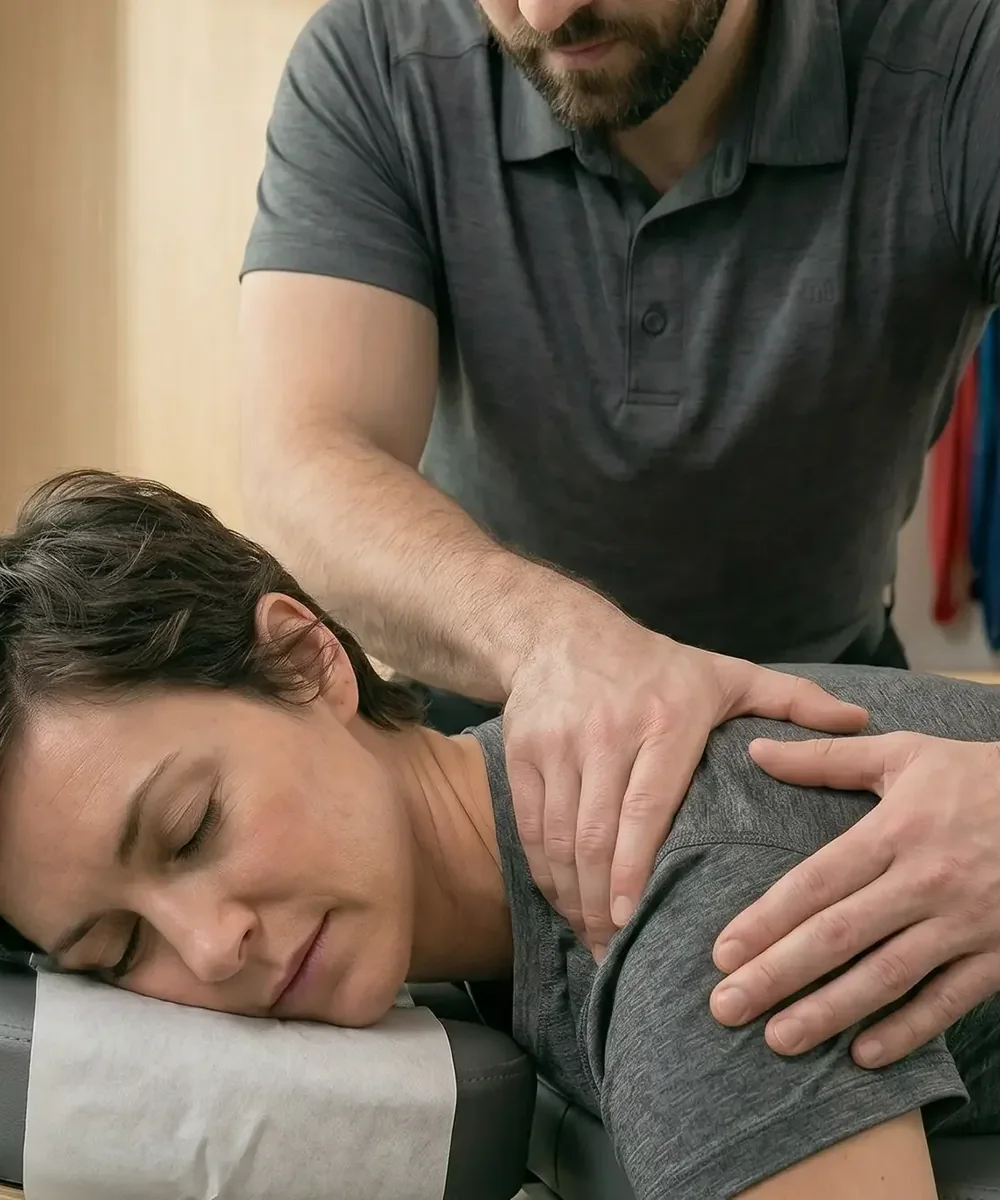
Treatment starts with a cause-first evaluation: testing how the shoulder blade, the upper spine, and the joint itself move and load together, because a shoulder that fails on the lift doesn’t always fail at the shoulder. We test, not guess. From there, care moves through four named phases.
You work one-on-one with a licensed physical therapist, every visit. Pennsylvania allows direct access, so no referral is needed to start, and the initial evaluation runs about 90 minutes so there’s time to test the range properly rather than take your word for where it stops.
The plan’s endpoint is named at your evaluation, reviewed with you every phase, because the goal is to get you back to your week, not to keep you on the schedule.
Calm it down.
Hands-on manual therapy and positions that unload the irritated tendon or capsule, starting the first visit. Most patients notice a meaningful difference within the first few sessions.
Restore what’s stuck.
Mobility work for the shoulder blade and the joint capsule actually restricting you, dosed to what the shoulder can tolerate that week, not a printed sheet handed to everyone.
Build strength you trust.
Progressive rotator cuff and shoulder-blade strength against standards you clear before moving on, so reaching overhead becomes load-tolerant again, not just briefly pain-free.
Make it stay fixed.
Testing before you’re cleared, including return-to-throw or return-to-lift standards where they apply, then a home program sized to your job, your sport, or your gym week.
What does getting better look like?
People who end up booking an evaluation for shoulder pain are rarely the ones who tore something in a single dramatic lift. More often it’s a slower story: months of quietly favoring the other arm, skipping anything that means reaching overhead, deciding that a stiff shoulder is simply part of getting older. If that’s closer to your version, you’re the typical patient here, not an outlier.
Most patients notice a difference within the first two or three visits, since treatment starts at the evaluation itself rather than after a week of paperwork. From there, progress tends to show up in ordinary places first: the top shelf without switching arms, a full night on either side, lifting a bag off the passenger seat without bracing for it.
Left alone, the cause behind a stiff shoulder rarely stays put; it teaches the rest of the arm and the shoulder blade to compensate, and the compensation is its own problem by the time anyone calls.
An evaluation turns that guesswork into a plan with an endpoint, named at the start and reviewed with you at every phase. Not an open-ended schedule, and not a promise made before anyone has looked at you.
Which services treat shoulder pain?
Physical Therapy
Is the foundation of treatment: the cause-first evaluation and the four-phase plan that runs the whole recovery.
02Orthopedic Therapy
Runs the joint-by-joint testing behind an impingement, a capsule that has tightened, or a repair that stalled short of full range.
03Sports Rehab
Runs the return-to-throw and return-to-lift testing for overhead athletes, so the shoulder clears standards before it carries full load again.
04Dry Needling
Targets the guarding in the rotator cuff and shoulder-blade muscles when it isn’t releasing with manual therapy alone.
“The physical therapist that I work with retired and I recently had a shoulder replacement. I decided to come here and was quickly glad that I did. I have received excellent care and everyone at the office is very nice and really friendly. If you need to do therapy, you should definitely come here!”Donna F. · Patient review
Questions, answered plainly.
The things people ask on the phone about their shoulder, written down.
It might be, but a tear isn’t something to diagnose from home, and plenty of shoulder pain comes from irritation or impingement with no tear at all. The evaluation tests strength, motion, and the specific movements that reproduce your pain, which usually points to the cause without imaging first. If something looks like it needs a scan or a physician’s opinion, we’ll say so and point you there directly.
Usually neither. Pennsylvania allows direct access, so no referral is needed to be evaluated here. Most shoulder pain can be evaluated and treated on movement, strength, and provocation testing, and treatment often starts making a difference before a scan would even be scheduled. If your exam findings suggest something imaging should confirm, we’ll refer you for that directly.
No. Both sides of a surgery are ordinary work here: preparing a shoulder beforehand so it starts recovery stronger, and rebuilding motion and strength afterward on the surgeon’s protocol. Patients also come to us months or years after an operation, when the range never fully came back. Later than ideal is not the same as too late, and the evaluation will tell you honestly what is still on the table.
Avoid pushing through a sharp or catching pain, sleeping in a position that pins the shoulder underneath you all night, and sudden heavy overhead lifting before you have been cleared. Beyond that, complete rest is rarely the fix: most people do better learning which ranges are safe to load than by keeping the arm still and waiting. Your evaluation will tell you exactly what to modify and for how long.
Start with a cause-first evaluation for your shoulder.
Put it in writing.
Six short questions. A real person calls you back, usually within two business hours, with times that fit your week.
The people who end up filling this out are rarely in the worst pain of their life. They’re just done working around it, done picking the errand that doesn’t require the stairs. If that’s the stage you’re at, this is the part where you stop researching and start.
Consider it filed.
A real person will call you back, usually within two business hours, with appointment times that fit your week. Keep your phone nearby.
Can’t wait? Call (724) 628-7288 ⟶Two clinics. Same standard in both.
Connellsville and Scottdale, both fully staffed, both easy to park at. Come see either one before you commit, if you like.
Clinic 01 · Connellsville
Directions to Connellsville ⟶ (opens in a new tab)
Clinic 02 · Scottdale
Directions to Scottdale ⟶ (opens in a new tab)