Request an appointment
No referral needed. A real person calls you back, usually within two business hours.
Connellsville, PA · Services
Laser therapy in Connellsville.
Low-level laser, sometimes called photobiomodulation: a small adjunct used at particular moments inside a plan, alongside the hands-on and loading work that does the heavy lifting. Never a course you buy on its own.
What is laser therapy in Connellsville?
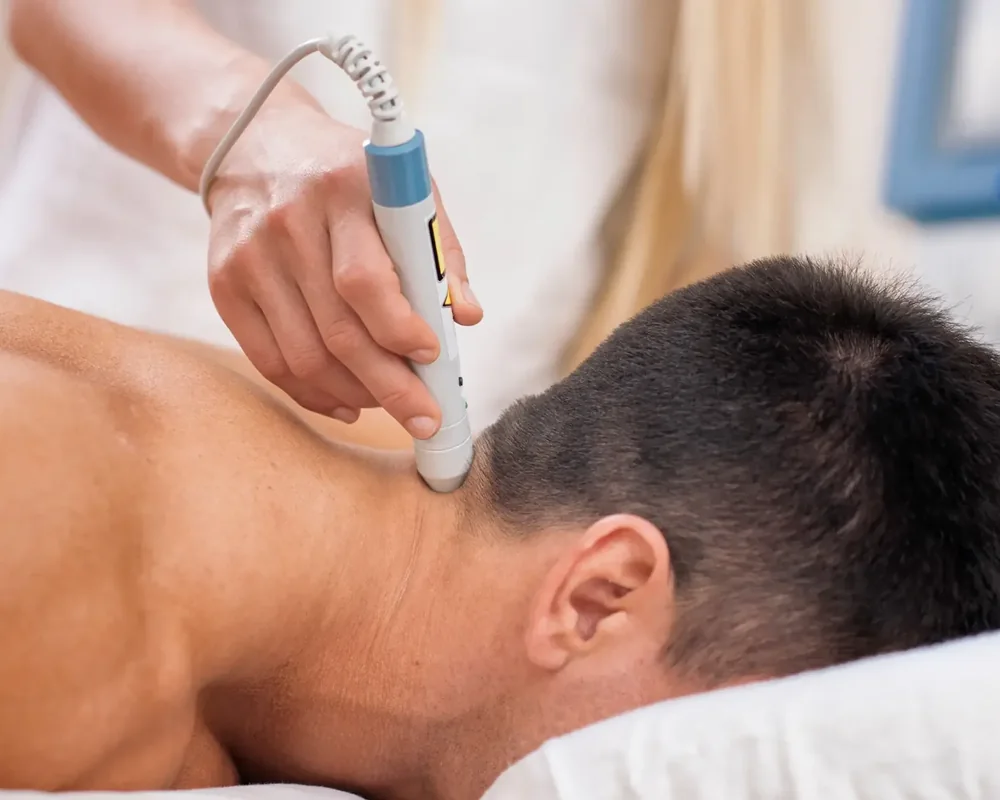
Laser therapy in a physical therapy clinic means low-level laser, also called photobiomodulation, and sometimes cold laser. A handheld emitter delivers light at particular wavelengths into the tissue for a few minutes at a time. It does not cut and it does not burn. It is not the surgical laser the word usually brings to mind. Most patients feel very little during it: a faint warmth at most, and often nothing at all.
Now the honest framing, because this modality attracts more enthusiasm than it has earned. Laser therapy is adjunctive. It is commonly used alongside hands-on treatment and loading work, aimed at settling an irritable area enough that the rest of the session goes better. It is not the reason a plan works, and a clinic that sells it as the centerpiece is selling you the wrong thing. We are not going to put a percentage or a success rate on this page, because none we could stand behind has been supplied, and a made-up number would be worse than no number.
Like everything else here, it sits inside a cause-first evaluation and a plan that runs the four named phases: Pain, Prime, Perform, and Prevent. When it is used at all, it is almost always early, in Pain, on an area still too irritable for hands-on work to be tolerable. As the area settles, laser drops out and the real work continues. Your licensed physical therapist will tell you at the evaluation whether it fits your plan at all, and often the answer is no.
Calm it down.
Hands-on treatment begins at the first visit. You leave understanding what’s actually going on, and you feel a difference early.
Restore what’s stuck.
Targeted mobility work for the joints and tissue actually holding you back, dosed to your body, not a printed sheet.
Build strength you trust.
Progressive load against standards you have to clear before moving on. Confidence, here, is a training effect.
Make it stay fixed.
Testing before you’re cleared, then a keep-it-gone program sized to your real week. Then we graduate you.
What is laser therapy commonly used for?
Laser gets considered when an area is irritable enough that everything else in the session is limited by it. A sample of where it is commonly used, always alongside the rest of the plan:
Chronic pain ⟶
An area that has been sensitive long enough that hands-on work has to start very gently.
02Elbow, wrist & hand pain ⟶
A tendon that objects to being touched well before it will tolerate being loaded.
03Arthritis ⟶
A joint having a bad week, where the goal is simply getting through a productive session.
04Foot or ankle pain ⟶
A tender heel or arch that has to settle before the loading work can start at all.
The risk with a comfortable modality is not that it hurts you. It is that it feels like progress. Visits can quietly turn into something you receive rather than something you do, and the strength work that actually keeps the problem from coming back never gets scheduled. That is why laser here is timed, limited, and always followed by the part that does the work.
What does a laser therapy session look like?
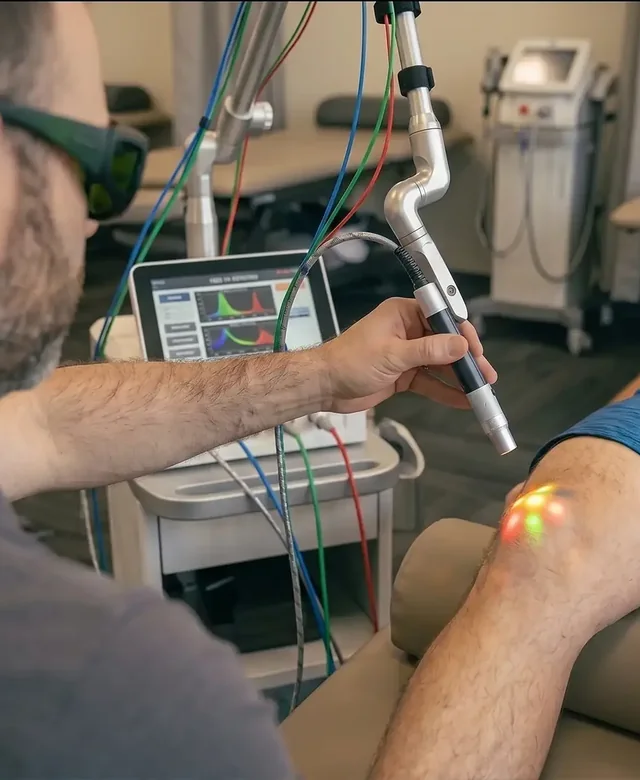
It is a short block inside a normal visit, not an appointment of its own. Your licensed physical therapist positions the emitter over the target area and holds or parks it there for a few minutes. You both wear protective eyewear. There is no needle, no pressure, and nothing to recover from afterward.
Most patients report feeling little or nothing during treatment, sometimes a mild warmth. There is no downtime and nothing to manage at home. If an area feels more irritable afterward rather than less, say so, because that is useful information about whether it belongs in your plan at all.
The visit does not end there. Laser is scheduled to buy a window, and the window gets used: hands-on work through the range, then loading, in the same hour. If a visit ever consists of laser and nothing else, something has gone wrong with the plan and it is worth asking about out loud.
Who laser therapy is for, and who it isn’t.
Laser fits patients with an area irritable enough to limit what else can happen in a session, who are already inside a plan, and who understand it as a support rather than a treatment. It does not fit anyone hoping to buy a course of laser instead of doing the mobility and strength work, and we would rather say that here than at the sixth visit.
If you have read this far waiting for the catch, there isn’t one, but there is a limit: this is a small tool with a modest job. Preferring the clinic that says so over the one that promises more is not cynicism. It is how you avoid paying for a course of something that was never going to be the answer.
Your licensed physical therapist screens before using it. Laser is avoided over known or suspected malignancy, directly over the thyroid, over the abdomen during pregnancy, over the eyes, and over areas with active bleeding. Photosensitizing medications and some skin conditions change the answer too. Bring your medication list to the evaluation so that conversation happens before anything is switched on.
Good fit
- An irritable area that is limiting what else can happen in a session
- Already inside a plan, with hands-on and loading work as the main event
- Comfortable with an adjunct measured in minutes, not in sessions
- Willing to report honestly whether it made any difference
Not the right fit
- Over known or suspected malignancy
- Directly over the thyroid, the eyes, or the abdomen during pregnancy
- Areas with active bleeding, or certain skin conditions (screened at evaluation)
- Anyone looking to buy a course of laser instead of doing the rest of the plan
What laser therapy works alongside.
Laser buys a window. These are the things that walk through it, and they are the reason the plan works.
Manual Therapy ⟶
The hands-on work the window is bought for, in the same visit.
02Dry Needling ⟶
The other tool that gets called in when a muscle will not release on its own.
03Therapeutic Ultrasound ⟶
The other adjunct in the same drawer, with the same modest job description.
04Physical Therapy ⟶
The evaluation and the plan that decide whether laser is used at all.
“Amazing staff and walked out with 0 pain! I would highly recommend this place to anyone who needs physical therapy.”Kylie H. · Patient review
Laser therapy questions, answered plainly.
No. Most patients feel very little during it, sometimes a faint warmth and often nothing at all. There is no needle, no pressure, and no recovery time afterward. You and your licensed physical therapist both wear protective eyewear while the emitter is on.
That depends on the person and the area, and we are not going to quote you a number. Laser therapy is adjunctive here. Many patients report that an irritable area is easier to work on afterward, which is the specific job it is being asked to do. It supports the hands-on and loading work rather than replacing it, and if it is not making a difference for you it comes out of the plan.
No, and it should never be sold to you that way. Laser is used to calm an area enough that the rest of the session goes better. The mobility work and the progressive loading are what change the outcome. If a visit ever consists of laser and nothing else, something has gone wrong with the plan.
Here, no. Laser is a short block inside a regular physical therapy visit, used once a cause-first evaluation decides it has a job to do. Your licensed physical therapist will tell you at your evaluation whether it fits your plan at all, and often the answer is no.
Start with the evaluation that decides what you actually need.
Put it in writing.
Six short questions. A real person calls you back, usually within two business hours, with times that fit your week.
The people who end up filling this out are rarely in the worst pain of their life. They’re just done working around it, done picking the errand that doesn’t require the stairs. If that’s the stage you’re at, this is the part where you stop researching and start.
Consider it filed.
A real person will call you back, usually within two business hours, with appointment times that fit your week. Keep your phone nearby.
Can’t wait? Call (724) 628-7288 ⟶Two clinics. Same standard in both.
Connellsville and Scottdale, both fully staffed, both easy to park at. Come see either one before you commit, if you like.
Clinic 01 · Connellsville
Directions to Connellsville ⟶ (opens in a new tab)
Clinic 02 · Scottdale
Directions to Scottdale ⟶ (opens in a new tab)