

Connellsville, PA · What we treat
Hip and knee pain in Connellsville.
The hip and the knee share muscles, share load, and share the blame: a cause-first evaluation works out which joint is actually driving this, then a plan with an endpoint gets you back to stairs, the car, and standing up from a low chair without the wince first.
You’ve probably said one of these.
Nobody walks in describing patellofemoral irritation or a labral tear. They describe a Tuesday. Tap one that sounds like your week.
-
UsuallyIrritation around the kneecap, which tends to complain more about descending than about climbing.
Why does this happen ⟶ -
UsuallyA hip that has lost rotation, so the leg swings out and around instead of through.
Why does this happen ⟶ -
UsuallyQuads and glutes that have quietly stopped carrying the load, so your arms took the job.
Why does this happen ⟶
- “I switched which side I sleep on, then switched back, and neither one works anymore.”
- “Turning to grab something behind me, my knee gives this little catch.”
- “I used to walk the whole store. Now I’m doing math about how far the car is.”
If two or three of those sound like your week, you’re not describing a mystery. You’re describing a pattern we see often, and one an evaluation is built to explain.
If you’re reading a condition page instead of buying a fourth brace, that isn’t overthinking. That’s good judgment.
Why does hip and knee pain happen?
There’s rarely one single cause, which is exactly why guessing doesn’t work. What we usually find, alone or in combination:
- Irritation around the kneecap. The classic runner’s knee pattern, tending to flare with stairs, squats, and downhill walking, and often quiet the moment you sit down.
- Bursitis or tendinopathy at the hip. The cushion or the tendons on the outside of the hip, irritated enough to ache with side-sleeping, a long walk, or the first three stairs.
- Meniscus irritation. The knee’s cartilage cushion catching or aching, often after a twist, a deep squat, or simply years of load.
- Labral irritation at the hip. The cartilage rim around the socket getting pinched, usually surfacing as a catch deep in the front of the hip when you pivot or sit low.
- Joint wear and lost strength together. Gradual change in the cartilage of either joint, made much louder by quads and glutes that have quietly given up capacity over a slow year.
The two joints are not independent. A hip that has stopped rotating will hand the difference to the knee, and a knee that has stopped bending fully will change how the hip loads within a few weeks. That is why we test both, every time, along with the pelvis above them.
None of these are diagnoses you make yourself, and most don’t require imaging to start treating. That’s what the evaluation sorts out.

How do we treat hip and knee pain in Connellsville?
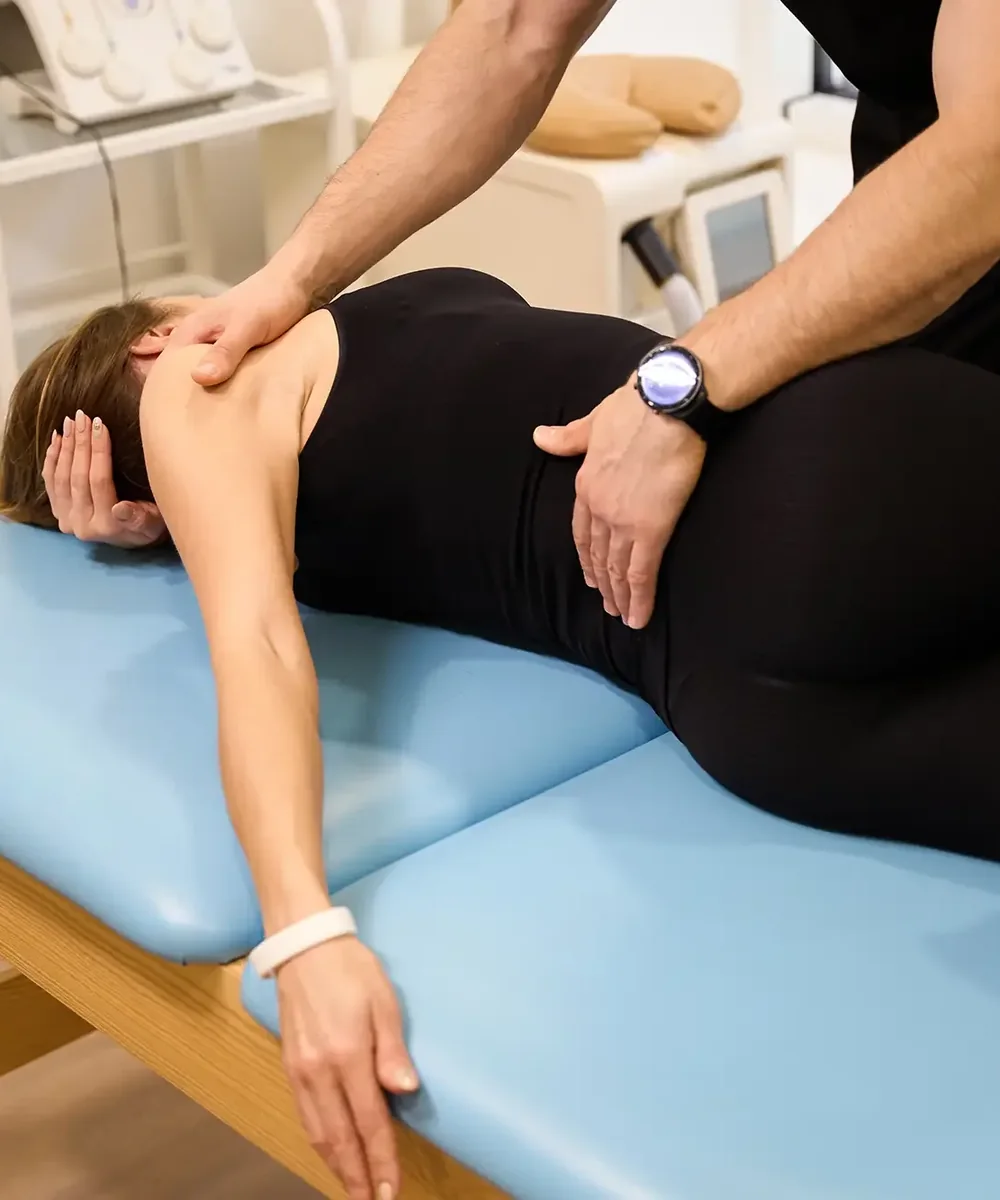
Treatment starts with a cause-first evaluation: testing how the hip, the knee, and the pelvis move and load together, not just pressing on the spot that hurts, because where it hurts isn’t always why it hurts. You work one-on-one with a licensed physical therapist, every visit. From there, care moves through four named phases.
The plan’s endpoint is named at your evaluation and reviewed with you every phase, because the goal is to get you back to your week, not to keep you on the schedule.
Calm it down.
Hands-on manual therapy and positions that unload whichever joint is actually irritated, starting the first visit. Most patients notice a meaningful difference within the first few sessions.
Restore what’s stuck.
Mobility work for the hip capsule and for the knee itself, dosed to what the joint tolerates that week rather than printed on a sheet in advance.
Build strength you trust.
Progressive glute, quad, and hamstring strength against standards you clear before moving on, so stairs, low chairs, and long walks become load-tolerant again, not just quiet.
Make it stay fixed.
Testing before you’re cleared, including a return to whatever you actually want back, then a home program sized to your real week rather than an ideal one.
What does getting better from hip and knee pain look like?
People who book an evaluation for a hip or a knee are rarely the ones who wrecked it in a single dramatic step. More often it is a slower story: a year of favoring one side, taking the elevator and calling it efficiency, deciding the limp is simply what happens now.
Most patients notice a difference within the first two or three visits, since hands-on treatment starts at the evaluation itself rather than a week later. From there, progress tends to show up in ordinary places first. Getting out of the car without the pause. Sleeping through the night on either side. Walking the whole store without counting the distance back.
Left alone, the cause behind a sore hip or knee rarely stays put; it teaches the other joint to compensate, and by the time anyone calls, the compensation has become its own problem.
An evaluation turns that guesswork into a plan with a specific estimate, reviewed with you at every phase. No referral needed: Pennsylvania allows direct access, so you can start with us.
Which services treat hip and knee pain?
Physical Therapy
The foundation of treatment: the cause-first evaluation and the four-phase plan that runs the whole recovery.
02Orthopedic Therapy
Where the joint-by-joint testing lives: rotation, glide, and load measured on both sides so the plan targets the right joint.
03Dry Needling
Targets the quad, glute, or hip-flexor guarding that builds around an irritated joint when it isn’t releasing with manual therapy alone.
04Blood Flow Restriction
Builds strength at light loads, which matters when the joint will not yet tolerate the weight the muscle needs.
“Best physical therapy facility! I’ve been to others over the years, but King’s worked wonders for me.”Bobbi R. · Patient review
Questions, answered plainly.
The things people ask on the phone about a sore hip or knee, written down.
Most hip and knee pain isn’t a medical emergency, but “serious” isn’t something to guess at from home. Sometimes the ache fades while the cause stays, which is why it comes back every time you climb a flight, sit low, or walk further than usual, often lasting a little longer each round. An evaluation tells you what you’re actually dealing with, and if anything looks like it needs a physician first, we’ll say so and point you there directly.
By testing both, and the pelvis above them, in the same visit. The two joints share muscles and share load, so a hip that has lost strength will often show up as a knee that aches, and a knee that has stopped bending fully will change how the hip works within a few weeks. That is exactly why the evaluation tests movement, strength, and control across the whole chain rather than treating the spot you point at.
Usually, yes, with modifications your licensed physical therapist gives you at the evaluation. Distance, incline, stair count, or particular lifts get adjusted for a phase, then put back once you’ve cleared the standard for that phase. You’ll get specific instructions for your week rather than a blanket “rest” order, because resting a stiff joint tends to make it stiffer.
No referral needed. Pennsylvania allows direct access, so you can book an evaluation with a licensed physical therapist without a prescription from a physician. We are in-network with most insurance plans, and the front desk will tell you what your plan covers before you commit to anything.
Start with a cause-first evaluation for your hip or knee.
Put it in writing.
Six short questions. A real person calls you back, usually within two business hours, with times that fit your week.
The people who end up filling this out are rarely in the worst pain of their life. They’re just done working around it, done picking the errand that doesn’t require the stairs. If that’s the stage you’re at, this is the part where you stop researching and start.
Consider it filed.
A real person will call you back, usually within two business hours, with appointment times that fit your week. Keep your phone nearby.
Can’t wait? Call (724) 628-7288 ⟶Two clinics. Same standard in both.
Connellsville and Scottdale, both fully staffed, both easy to park at. Come see either one before you commit, if you like.
Clinic 01 · Connellsville
Directions to Connellsville ⟶ (opens in a new tab)
Clinic 02 · Scottdale
Directions to Scottdale ⟶ (opens in a new tab)