

Connellsville, PA · Services
Manual therapy in Connellsville.
Skilled hands-on work for the joint that has stopped moving and the tissue that will not let go, performed by a licensed physical therapist inside a cause-first plan. This is treatment, not a massage.
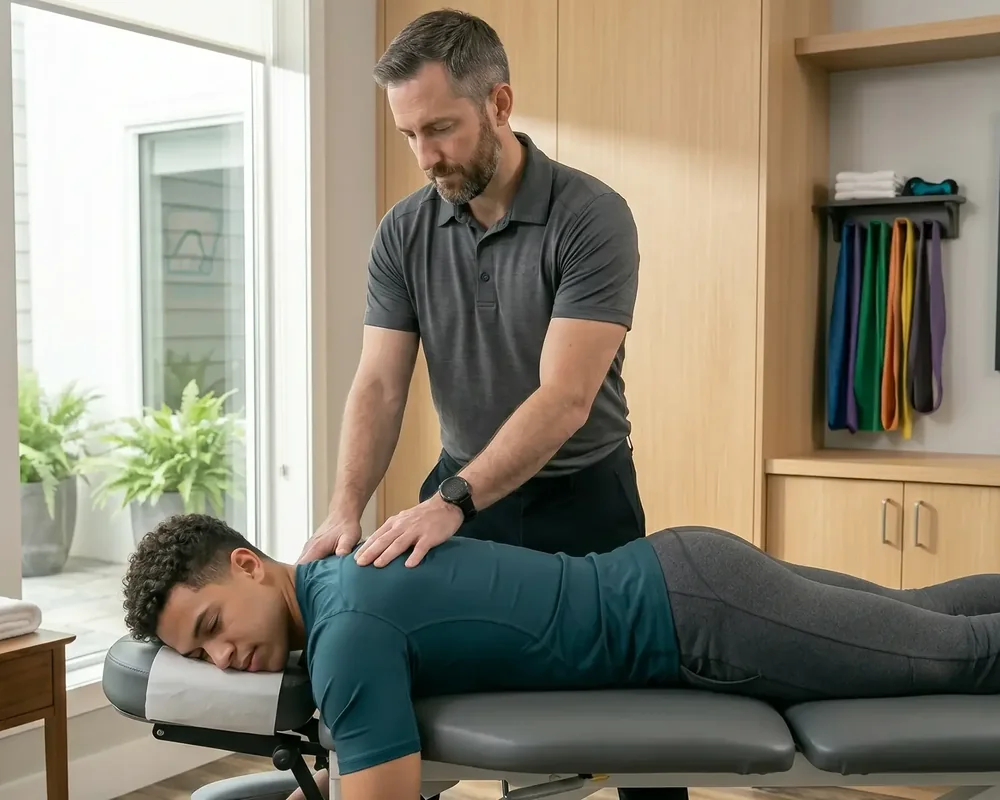
What is manual therapy in Connellsville?
Manual therapy is hands-on treatment applied directly to a joint or to soft tissue by a licensed physical therapist. In practice that means joint mobilization to restore the glide a stiff joint has lost, soft tissue mobilization to change the quality of a muscle that has been guarding for weeks, muscle energy techniques that use your own contraction to open range, and nerve mobility work where a nerve is not sliding the way it should. What gets treated is decided at your evaluation, by testing, not by where you point.
It is worth saying plainly, because people ask: this is not a massage, and we do not offer massage therapy here at all. A massage is a general relaxation service applied broadly to muscle, and there is nothing wrong with one. Manual therapy is a specific technique applied to a specific structure that testing identified, dosed deliberately, then retested in the same visit. It succeeds if the movement changed. How relaxing it felt is not the measure.
Dr. Hayley Skovira holds a Manual Therapy Certification, and hands-on treatment is part of every visit here rather than an upgrade you book separately. Manual therapy earns most of its ground early, in Pain and Prime, opening range so the strength work in Perform has somewhere to go. Pain, Prime, Perform, Prevent, in that order, always.
Calm it down.
Hands-on treatment begins at the first visit. You leave understanding what’s actually going on, and you feel a difference early.
Restore what’s stuck.
Targeted mobility work for the joints and tissue actually holding you back, dosed to your body, not a printed sheet.
Build strength you trust.
Progressive load against standards you have to clear before moving on. Confidence, here, is a training effect.
Make it stay fixed.
Testing before you’re cleared, then a keep-it-gone program sized to your real week. Then we graduate you.
What conditions does manual therapy treat?
Manual therapy gets called on where a joint has lost range or a tissue has stayed guarded, and where movement alone has not been able to get in. A sample of what it commonly supports:
Neck pain ⟶
The segment that stopped rotating, and the morning you woke up unable to check the left mirror.
02Headaches ⟶
The kind that starts as tightness at the base of the skull and arrives behind one eye by four o’clock.
03Shoulder pain ⟶
The shoulder that stalls halfway up and the shoulder blade that stopped gliding with it.
04Back pain & sciatica ⟶
The stiff hinge low in the back that ten minutes of stretching has never quite reached.
05Hip & knee pain ⟶
The hip that has quietly stopped rotating, and the knee that will not straighten the last few degrees.
06TMJ & TMD ⟶
The jaw that clicks, catches, or makes a sandwich a two-part decision.
07Elbow, wrist & hand pain ⟶
The wrist that lost motion after a cast, and the forearm that has stayed corded since.
08Arthritis ⟶
A worn joint that still has unused range in it and gets stiffer the less it is asked for.
Stiffness is patient. A joint that has lost a little glide rarely announces it. It quietly hands the work to the joint next door, and the neighbor is the one that starts hurting. Left alone long enough, the complaint you finally book about is often not the joint that started any of it.
What does a manual therapy session look like?
Manual therapy happens inside a regular visit, not as its own appointment. Your therapist finds the restricted segment or the guarded tissue by hand, applies a graded technique to it, and then immediately retests the movement that was limited. If the movement changed, the technique stays in your plan. If it did not, that is information too, and the plan changes rather than repeating itself for six weeks out of habit.
Most of it is quiet and unremarkable to watch: sustained pressure, a joint taken to the end of its range and worked there, a muscle lengthened while you push gently against a hand. The visit then continues into movement and loading work, always, because range that is not used tends to get handed straight back within a day or two. The hands open the door. The exercise is what walks through it.

Who manual therapy is for, and who it isn’t.
Manual therapy fits a joint that has lost range, tissue that stays guarded no matter how much you stretch it, a neck or back that has been stiff since a specific week you can still name, and the restricted feel that follows an injury or a spell in a sling or a boot. It is also useful when pain has made a joint so protective that active exercise on its own simply cannot get in yet.
If you came looking for hands-on care because the last place put you on a machine for an hour and sent you home with a printed sheet, that is not a preference for being pampered. It is a reasonable request for treatment, and here it is already part of every visit rather than something you have to ask for.
It is not appropriate over an unhealed fracture, an area of active infection, a joint with an unstable or unresolved diagnosis that has not been looked at yet, or where certain bone density and vascular conditions make joint work unsafe. Your therapist screens for all of that at your evaluation, before any hands go on. And to be clear one final time: we do not offer massage therapy, so if a relaxation massage is what you are after, we are the wrong address and would rather say so now.
Good fit
- A joint that has lost range, or tissue that stays guarded through stretching
- Stiffness after an injury, a cast, a sling or a boot
- Pain protective enough that active exercise alone can’t get in yet
- Inside a physical therapy plan, followed by movement work the same visit
Not the right fit
- An unhealed fracture, active infection, or an unstable joint that hasn’t been imaged
- Certain bone density and vascular conditions, screened at your evaluation
- Anyone looking for a relaxation massage: we don’t offer massage therapy
Physical therapy ⟶
The cause-first evaluation and the plan these hands are working inside of.
02Spinal manipulation ⟶
A faster, more specific technique for a spinal segment, when screening says it fits.
03Dry needling ⟶
For the trigger point that hands alone haven’t been able to reach.
04Cupping ⟶
Decompression for tissue that responds better to lift than to pressure.
Manual therapy is one set of tools inside the plan, chosen because testing pointed at it. See the full list of services.
“Very friendly, knowledgeable staff. Therapists truly listen to problems and actively work to resolve them! Highly recommended!”Camille S. · Patient review
Questions, answered plainly.
No, and we do not offer massage therapy here at all. A massage is a general relaxation service applied broadly to muscle. Manual therapy is a specific hands-on technique applied by a licensed physical therapist to a particular joint or tissue that testing identified, then retested in the same visit to see whether the movement actually changed.
Most of it does not. Some techniques press into tissue that is already sore, or take a stiff joint out to the end of its range, and that can be briefly uncomfortable. Your therapist works within what you can tolerate and asks rather than assumes. Mild soreness the next day is common, similar to the day after a good workout, and it usually settles on its own.
No. Hands-on treatment is part of a regular physical therapy visit here rather than an add-on you schedule separately. Which techniques you get, and how much of the visit they take up, is decided by what your evaluation found and by which phase of your plan you are currently in.
A licensed physical therapist, one-on-one, for the whole visit. Dr. Hayley Skovira holds a Manual Therapy Certification, and hands-on work is part of how every clinician here treats, so you are not handed off to someone else once the table work is over. No referral is needed to book the evaluation, since Pennsylvania allows direct access.
Start with the evaluation that finds the restriction.
Put it in writing.
Six short questions. A real person calls you back, usually within two business hours, with times that fit your week.
The people who end up filling this out are rarely in the worst pain of their life. They’re just done working around it, done picking the errand that doesn’t require the stairs. If that’s the stage you’re at, this is the part where you stop researching and start.
Consider it filed.
A real person will call you back, usually within two business hours, with appointment times that fit your week. Keep your phone nearby.
Can’t wait? Call (724) 628-7288 ⟶Two clinics. Same standard in both.
Connellsville and Scottdale, both fully staffed, both easy to park at. Come see either one before you commit, if you like.
Clinic 01 · Connellsville
Directions to Connellsville ⟶ (opens in a new tab)
Clinic 02 · Scottdale
Directions to Scottdale ⟶ (opens in a new tab)