

Connellsville, PA · Services
Dry needling in Connellsville.
Precise, targeted work for the muscle knot that’s outlasted stretching, foam rolling, and time: a tool inside a cause-first plan with a licensed physical therapist, never a treatment on its own.
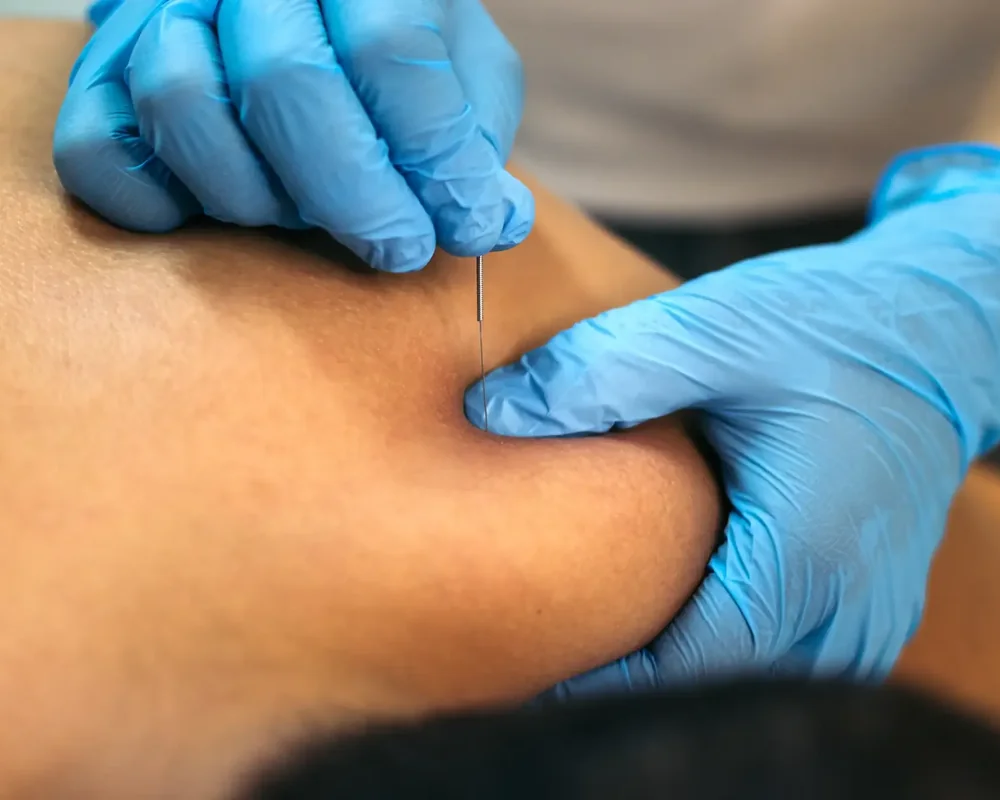
What is dry needling in Connellsville?
Dry needling uses a thin filament needle placed directly into a tight band of muscle, a trigger point, to release it in a way manual pressure alone often can’t reach. It is not acupuncture, and it isn’t aimed at energy meridians. The target is a specific, palpable knot found by hand during your evaluation, and the goal is a measurable change in how that muscle moves once the needle comes out.
That is also why dry needling never stands alone here. It shows up inside a cause-first evaluation and a plan that still runs through the four named phases, Pain, Prime, Perform, and Prevent. It tends to earn its place early, in Pain and Prime, when a stubborn knot is blocking mobility work from taking hold. Once the tissue releases, the plan moves on to the strength and movement work that addresses why the muscle tightened in the first place. Needling calms the muscle down. It does not replace the reason it was guarding.
Every session is performed by a licensed physical therapist trained in the technique, using a sterile, single-use needle, as one tool inside your broader plan. It is not a service you book on repeat instead of doing the rest of the work, and we will say so if that is what you are hoping for.
Calm it down.
Hands-on treatment begins at the first visit. You leave understanding what’s actually going on, and you feel a difference early.
Restore what’s stuck.
Targeted mobility work for the joints and tissue actually holding you back, dosed to your body, not a printed sheet.
Build strength you trust.
Progressive load against standards you have to clear before moving on. Confidence, here, is a training effect.
Make it stay fixed.
Testing before you’re cleared, then a keep-it-gone program sized to your real week. Then we graduate you.
What conditions does dry needling treat?
Dry needling gets called in for problems where a specific muscle has tightened into a trigger point that is resisting stretching and hands-on work on its own. A sample of what it commonly supports:
Neck pain ⟶
The corded band at the base of the skull that turns a shoulder check into a whole-body maneuver.
02Shoulder pain ⟶
The knot in the upper trap or around the rotator cuff that keeps an overhead reach guarded.
03Back pain & sciatica ⟶
The deep paraspinal tightness that a morning of stretching alone never quite touches.
04Hip & knee pain ⟶
The hip flexor, glute, or quad trigger point turning a simple stride into a limp by the end of a shift.
A trigger point left alone rarely just sits there quietly. It changes how you move around it, guarding a shoulder or a hip until other muscles pick up work they were never built for and develop their own trouble. Needling the knot directly, inside a plan that treats the actual cause, is usually faster than waiting for it to let go on its own.
What does a dry needling session look like?
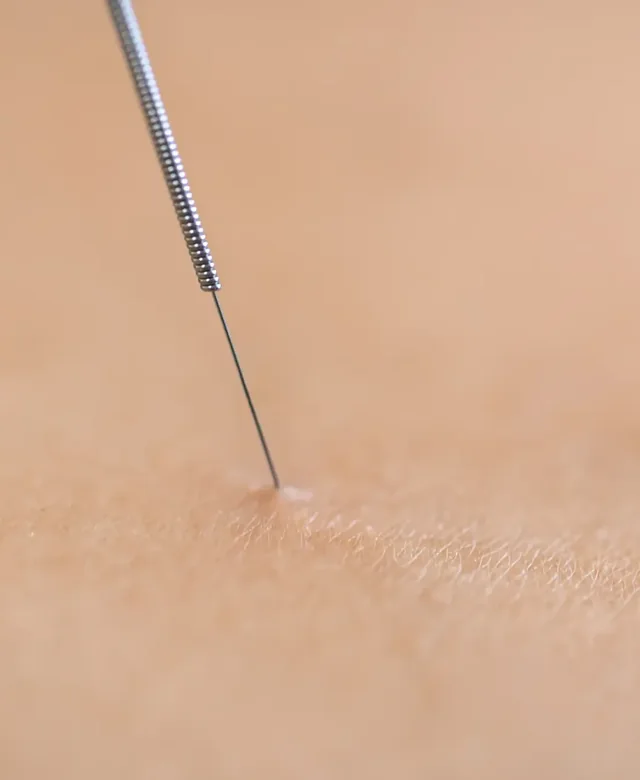
Dry needling is scheduled as part of a regular visit, not a separate appointment. Your licensed physical therapist finds the trigger point by feel, places a thin, sterile, single-use needle into the muscle, and works it until the band lets go. It usually takes a few minutes per area, and it often produces a brief involuntary twitch, which is a sign the right spot was found.
Most patients feel a deep ache or a cramp during the release itself, then a looseness in the area that hands-on work alone had not produced. The needles come out, the area gets a moment, and the same visit typically carries on into mobility or strength work while the muscle is primed to move. That sequence is deliberate. The needling is meant to open a window, not close the file.
Mild soreness afterward, close to what a hard workout leaves behind, is common and usually settles within a day or two. You get told that before anything is scheduled, along with what to do about it.
Who this is for, and who it isn’t.
Dry needling tends to fit patients whose evaluation turns up a specific, stubborn trigger point: the knot that’s been in the same square inch since spring, that hasn’t answered to stretching, foam rolling, or hands-on work alone. It is most useful as an accelerant inside a plan that is already running, not as a first appointment on its own.
The people who ask for dry needling by name are usually the same sort. They’ve already tried the general stuff, they want the specific spot addressed directly, and they understand it is one tool among several rather than a substitute for the rest. If that’s you, your instinct is sound, and it’s worth raising at your evaluation.
It is not appropriate for patients with a needle phobia that can’t be worked through, active infection or open wounds near the target area, or certain bleeding disorders and pregnancy considerations your therapist screens for before ever picking up a needle. That screening happens at your evaluation, before anything is scheduled, and the answer is sometimes no.
Good fit
- A specific, stubborn trigger point that stretching and hands-on work haven’t released
- Part of an existing physical therapy plan, not a first appointment on its own
- Comfortable with one tool among several rather than a single fix
- Willing to do the mobility and strength work in the same visit while the window is open
Not the right fit
- Needle phobia that can’t be worked through
- Active infection or open wounds near the target area
- Certain bleeding disorders and pregnancy considerations, screened at evaluation
- Anyone looking to book it on repeat instead of doing the rest of the plan
Physical Therapy ⟶
The cause-first evaluation and the plan dry needling is built to serve.
02Manual Therapy ⟶
Hands-on work on the joint and tissue around the knot, usually in the same visit.
03Cupping ⟶
Decompressive work for a broader guarded area when the problem isn’t one tidy point.
Dry needling is a tool inside the plan, never a standalone treatment.
“Kings has been a great place for myself or anyone that needs to receive physical therapy. My physical results have been improved and the staff and therapist are a pleasure to work with.”Joseph K. · Patient review
Questions, answered plainly.
Most patients feel a deep, brief ache or a muscle cramp during the release itself, not the sharp sting of a typical injection needle. It tends to fade quickly, and the area often feels noticeably looser within a day. Mild soreness afterward, similar to a hard workout, is common and usually settles within a day or two.
No. Both use thin filament needles, but the similarity ends there. Dry needling targets a specific, palpable trigger point found during a physical therapy evaluation, aimed at a measurable change in muscle function. It is not based on energy meridians and is not performed as a standalone wellness treatment.
Here, no. Dry needling is scheduled inside an existing physical therapy plan, following a cause-first evaluation that confirms it is the right tool for what is actually going on. It works best paired with the mobility and strength work that addresses the reason the muscle tightened in the first place, not as a stand-alone appointment.
It depends on how the trigger point responds and where you are in your overall plan. Some patients need it once or twice to break a specific knot loose. Others use it periodically through the Pain and Prime phases when a stubborn area resists everything else. Your licensed physical therapist will tell you at your evaluation whether it fits your plan at all.
Start with the evaluation that finds the knot.
Put it in writing.
Six short questions. A real person calls you back, usually within two business hours, with times that fit your week.
The people who end up filling this out are rarely in the worst pain of their life. They’re just done working around it, done picking the errand that doesn’t require the stairs. If that’s the stage you’re at, this is the part where you stop researching and start.
Consider it filed.
A real person will call you back, usually within two business hours, with appointment times that fit your week. Keep your phone nearby.
Can’t wait? Call (724) 628-7288 ⟶Two clinics. Same standard in both.
Connellsville and Scottdale, both fully staffed, both easy to park at. Come see either one before you commit, if you like.
Clinic 01 · Connellsville
Directions to Connellsville ⟶ (opens in a new tab)
Clinic 02 · Scottdale
Directions to Scottdale ⟶ (opens in a new tab)