

Request an appointment
No referral needed. A real person calls you back, usually within two business hours.
Connellsville, PA · Services
Blood flow restriction training in Connellsville.
Strength work at loads a healing joint can actually tolerate, using a calibrated cuff applied and monitored by a licensed physical therapist. One tool inside your plan, screened before it is ever used, never a session you book on its own.

What is blood flow restriction training in Connellsville?
Blood flow restriction training, usually shortened to BFR, uses a calibrated cuff placed high on an arm or a leg and inflated to a pressure your licensed physical therapist measures for that limb, on that day. The cuff limits blood flow out of the limb while you exercise with very light weight. The muscle then works under conditions it would normally only meet under a heavy bar. That is the whole idea: a strength stimulus at loads a healing joint can actually tolerate.
Here is the case for it in plain terms. After surgery, or when a joint is irritable, or when a tendon will not take load yet, the ordinary problem is that the exercise heavy enough to build strength is also heavy enough to set you back. BFR is the way around that gap. It is one of the few tools on this site that changes what is possible inside a plan rather than simply making an hour more comfortable, and it earns its place for exactly that reason.
It is still not a standalone service. BFR sits inside a cause-first evaluation and a plan that runs the four named phases: Pain, Prime, Perform, and Prevent. It usually appears in Prime and early Perform, holding the line on strength while the tissue underneath heals, and it steps aside as soon as the joint can take real load. Your licensed physical therapist will tell you at the evaluation whether it fits your plan at all.
Calm it down.
Hands-on treatment begins at the first visit. You leave understanding what’s actually going on, and you feel a difference early.
Restore what’s stuck.
Targeted mobility work for the joints and tissue actually holding you back, dosed to your body, not a printed sheet.
Build strength you trust.
Progressive load against standards you have to clear before moving on. Confidence, here, is a training effect.
Make it stay fixed.
Testing before you’re cleared, then a keep-it-gone program sized to your real week. Then we graduate you.
What does blood flow restriction training help with?
BFR gets called in when the goal is strength and the obstacle is load tolerance. A sample of what it commonly supports:
Pre and post surgery ⟶
The weeks after a repair, when the limb is off-limits for heavy work and losing strength by the day.
02Hip and knee pain ⟶
The knee that objects to a loaded squat long before the muscle around it has had enough.
03Sports injuries ⟶
Holding a season’s worth of strength on the injured side while it is still under a restriction.
04Arthritis ⟶
A joint that argues with heavy load on principle, attached to a muscle that still needs to get stronger.
Strength leaves faster than it comes back. A limb that spends six weeks protected does not simply pick up where it left off, and the gap that opens is usually what people are still fighting months later when they say the knee never felt the same. The point of the cuff is to make that gap smaller while the healing part is out of your hands.
What does a blood flow restriction session look like?
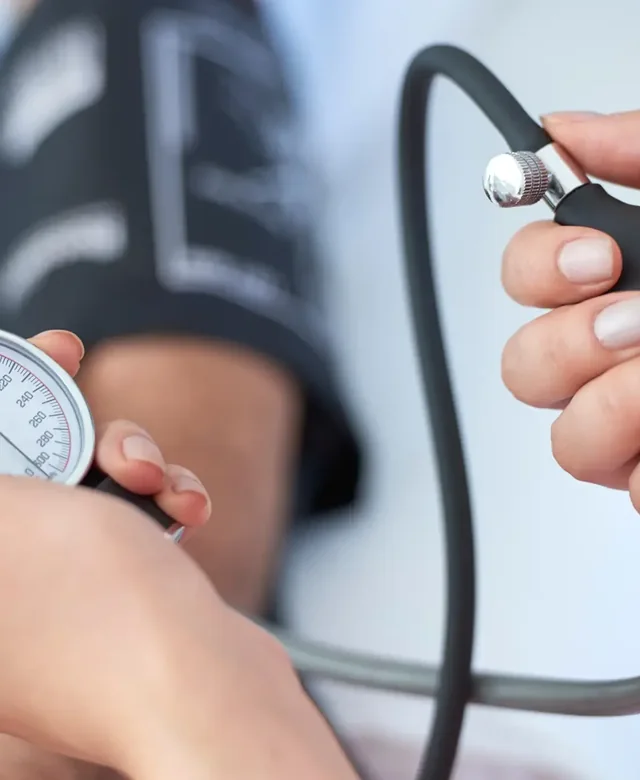
BFR happens inside a regular visit. Your licensed physical therapist measures the pressure at which blood flow in that limb actually stops, then works at a set fraction of it, using a proper medical cuff with a gauge rather than a wrap tightened by feel. The cuff goes on, you do several sets of a light exercise with short rests between them, and the cuff comes off. The whole block usually takes well under a quarter of the hour.
It is uncomfortable in a specific way. The limb aches, then burns, then feels heavy near the end of a set, entirely out of proportion to how little weight you are moving. It settles within about a minute of the cuff releasing. Numbness, pins and needles, or a pain that is sharp rather than burning are not part of it. Say so at once and the cuff comes off.
Your therapist stays with you for the whole block, and that is not a courtesy. Cuff pressure, set count, rest intervals, and how the limb is responding are all watched and adjusted while it happens. When the cuff comes off, the visit carries on with the mobility and loading work the plan calls for.
Who blood flow restriction is for, and who it isn’t.
BFR fits patients who need to build or hold strength while a joint, a repair, or a tendon cannot yet take heavy load. Most often that is the weeks after surgery, but it also covers an irritable joint in the middle of a plan and an athlete protecting one side while the rest of them keeps training.
If you have been told to rest a limb and you are quietly certain you are losing ground every week you comply, you are not being impatient. You are right. Raise the cuff at your evaluation, because that specific worry is the one it exists to answer.
The screening matters more here than anywhere else in this section, so it is worth stating in full. Before a cuff goes on anyone, your licensed physical therapist screens for cardiovascular and clotting risk: a history of blood clots or deep vein thrombosis, clotting disorders, uncontrolled blood pressure, certain heart conditions, vascular disease or a graft in the limb, active infection, an open wound where the cuff would sit, and pregnancy. Some of those rule BFR out entirely. Others mean a conversation with your physician before anything is scheduled. Bring your full history and your medication list to the evaluation.
One more thing, plainly. This is not a technique to copy at home with a resistance band or a strap around your thigh. The safety of it rests on knowing the pressure that limb needs and holding it there, which takes a calibrated cuff and someone watching the gauge. A band tightened until it feels about right is a different thing wearing the same name, and it is not safe.
Good fit
- Building or holding strength while a joint or repair can’t take heavy load
- The weeks after surgery, inside a plan your therapist is already running
- An irritable joint that objects to load long before the muscle has had enough
- Willing to be screened honestly, full medical history and medications included
Not the right fit
- A history of blood clots, deep vein thrombosis, or a clotting disorder
- Uncontrolled blood pressure, certain heart conditions, or vascular disease in the limb
- Active infection, or an open wound where the cuff would sit
- Pregnancy, or anything else flagged during the cardiovascular screening
- Anyone planning to try it at home with a band instead of a calibrated cuff
What blood flow restriction works alongside.
The cuff is a way to keep training when training is the problem. These are the plans it most often sits inside.
Orthopedic Therapy ⟶
The post-surgical and post-injury plan the cuff most often sits inside.
02Sports Rehab ⟶
The return-to-play standards the strength work is aiming at.
03Manual Therapy ⟶
The hands-on work that keeps the joint moving while the loading stays light.
04Physical Therapy ⟶
The evaluation and the plan that decide whether the cuff comes out at all.
“King’s Physical Therapy is an awesome place to heal and get better. They push you to extreme and they know your limits. The staff is very personable and you feel like family while you are there. Highly recommend them for all your therapy needs.”William B. · Patient review
Blood flow restriction questions, answered plainly.
It is safe when it is done properly, which means a calibrated medical cuff, a pressure measured for your limb, and a licensed physical therapist watching the whole block. It is screened for first. A history of blood clots, a clotting disorder, uncontrolled blood pressure, certain heart and vascular conditions, and pregnancy all change the answer. Tell your therapist your full history and your medications at the evaluation.
It is uncomfortable rather than painful. The limb burns and feels heavy toward the end of a set, out of all proportion to how light the weight is, and that feeling settles within about a minute of the cuff coming off. Numbness, pins and needles, or a sharp pain are not part of it. Say so immediately and the cuff comes off.
No, and please do not try. The safety of blood flow restriction rests on knowing the pressure that particular limb needs and holding it there, which takes a calibrated cuff with a gauge and someone monitoring you. A band or a wrap tightened until it feels about right is not the same technique and is not safe.
Usually only as long as heavy load is off the table. It tends to appear in the Prime and early Perform phases, holding strength while the tissue underneath heals, and it steps aside once the joint can take real weight. Your licensed physical therapist will tell you at your evaluation whether it fits your plan at all, and will tell you when it is no longer needed.
Start with the evaluation that decides whether the cuff comes out.
Put it in writing.
Six short questions. A real person calls you back, usually within two business hours, with times that fit your week.
The people who end up filling this out are rarely in the worst pain of their life. They’re just done working around it, done picking the errand that doesn’t require the stairs. If that’s the stage you’re at, this is the part where you stop researching and start.
Consider it filed.
A real person will call you back, usually within two business hours, with appointment times that fit your week. Keep your phone nearby.
Can’t wait? Call (724) 628-7288 ⟶Two clinics. Same standard in both.
Connellsville and Scottdale, both fully staffed, both easy to park at. Come see either one before you commit, if you like.
Clinic 01 · Connellsville
Directions to Connellsville ⟶ (opens in a new tab)
Clinic 02 · Scottdale
Directions to Scottdale ⟶ (opens in a new tab)