

Connellsville, PA · What we treat
Say what hurts. We’ll take it from there.
Nobody walks in already speaking clinical. Find the sentence that sounds like your week below, or the body part that’s been complaining, and read what it usually turns out to be.
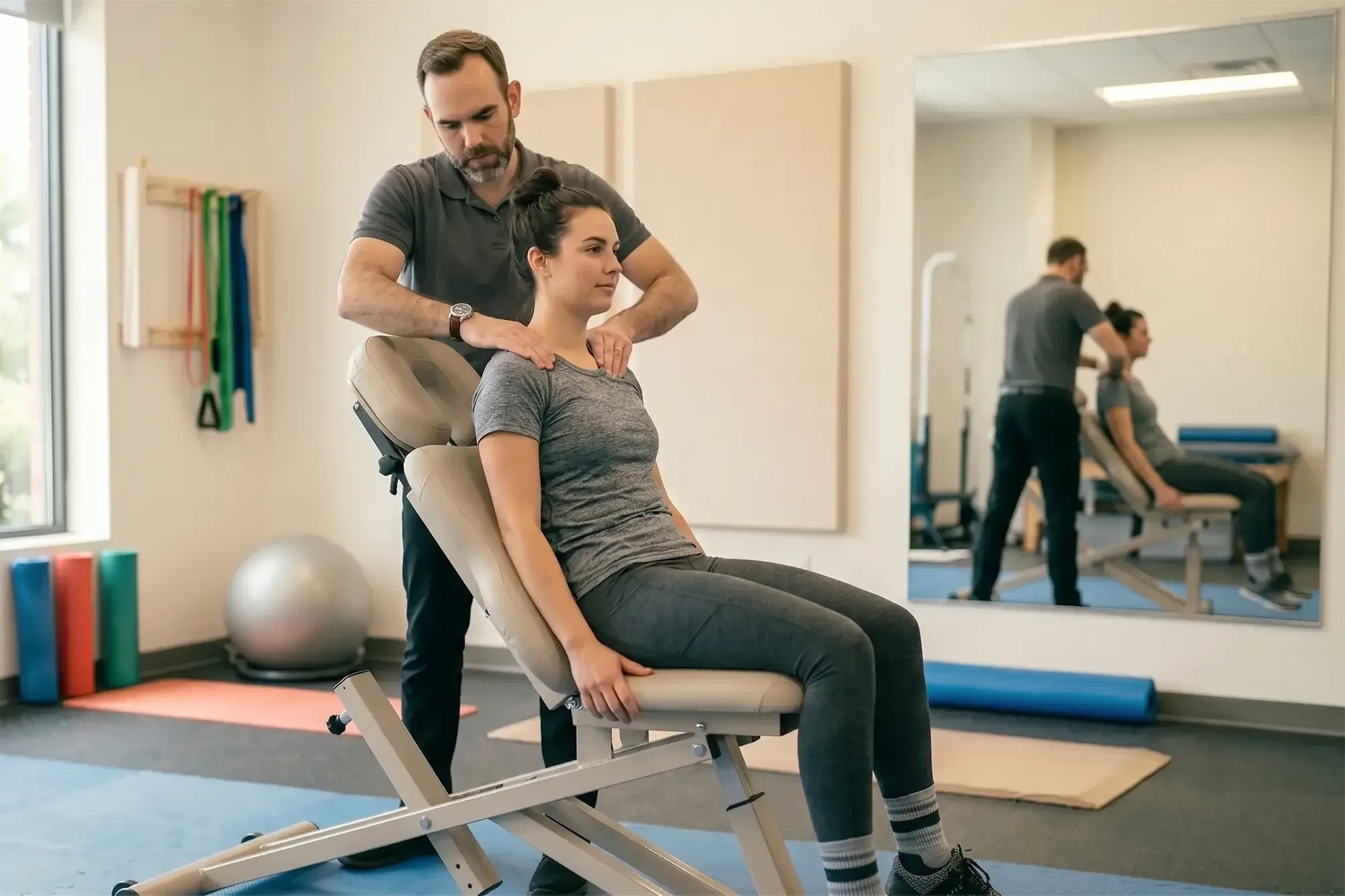
Most of what brings people in isn’t a diagnosis, it’s a sentence: the stairs that suddenly need a handrail, the arm you’ve started favoring without quite noticing when it started. Below are the sixteen complaints we see most often in Connellsville, each with what it usually turns out to be and a link to the plain-language version of how we treat it.
None of this replaces your evaluation, and none of it is a diagnosis; it’s context, so you’re not walking in blind. What it usually is for someone with your symptom isn’t always what it is for you, which is exactly why the evaluation exists: to test, not guess, and to find the actual cause instead of treating the spot that hurts because that’s the spot that’s loudest.
The one thing all sixteen have in common is what happens when they’re left alone. Pain that gets ignored doesn’t usually stay the same size. The shoulder you stopped reaching overhead with quietly teaches the rest of your body to cover for it, and the covering is its own problem by the time you finally call. A knee that’s been favored for a year has usually recruited the hip and the opposite ankle by then too. Earlier is easier, almost every time we’ve seen it, and none of the sixteen below need imaging or a referral before you can start sorting them out.
Sixteen things we treat, in your words.
Each one opens with the sentence we actually hear on the phone.
-
UsuallyStiff neck joints, or muscle that has been holding a bad position since a desk, a pillow, or one long drive. It responds well, and it responds early.
Neck pain ⟶ -
UsuallyHeadaches that start in the neck and refer up behind an eye or a temple. When the neck is the driver, treating the neck is what changes them.
Headaches ⟶ -
UsuallyRotator cuff irritation, a joint that has stiffened, or a shoulder blade that stopped doing its share. The catch on the way overhead is the tell.
Shoulder pain ⟶ -
UsuallyTennis or golfer’s elbow, carpal tunnel, or tendon irritation from a week of repeated gripping. Grip comes back once the cause, not the hand, is treated.
Elbow, wrist and hand pain ⟶ -
UsuallyLow back joints, a disc that’s irritated, or a nerve getting crowded, which is what sends it down the leg. The most treatable thing we see.
Back pain and sciatica ⟶ -
UsuallyHip bursitis or labral irritation, runner’s knee, worn joint surfaces, or a knee working back from ACL or MCL repair. Hips and knees answer to each other, so we test both.
Hip and knee pain ⟶ -
UsuallyPlantar fasciitis, Achilles tendon irritation, or an old sprain that never finished healing and quietly changed how you walk.
Foot or ankle pain ⟶ -
UsuallyJoint surfaces that have worn, and the muscles around them that have gone quiet. We can’t undo the wear. We can change how much of your week it runs.
Arthritis ⟶ -
UsuallyPain that has outlasted the healing timeline and become a habit the nervous system keeps. Progress gets measured in what you get back, not in what a scan says.
Chronic pain ⟶ -
UsuallyA sprain, strain, or overuse injury that needs to be tested back to sport rather than waited out. Clearance is a set of numbers you pass, not a date.
Sports injuries ⟶ -
UsuallyStrength and range built before an operation, and a staged plan after it. What you go in with has a lot to say about what you come out with.
Pre- and post-surgery ⟶ -
UsuallyStrength, sensation, vision and the inner ear all feed balance. We test which one has drifted, then train that one instead of guessing at all four.
Balance and gait disorders ⟶ -
UsuallyOften an inner ear problem, sometimes a neck one. Some cases settle with repositioning inside a visit or two; others need graded gaze and balance work.
Dizziness and vertigo ⟶ -
UsuallyNeck and back tissue that stiffened up once the adrenaline of the impact wore off. Delayed onset is normal, and it’s easier to unwind early than late.
Motor vehicle accident ⟶ -
UsuallyRetraining movement and control on the affected side, one specific task at a time. We start from the ability you name and work outward from there.
Stroke ⟶ -
UsuallyThe jaw joint and the muscles around it, often with a neck component. Chewing, yawning and talking all get tested, because those are the jobs the jaw has.
TMJ and TMD ⟶
Not sure what you have.
That’s the more common starting point, honestly. Most people who call don’t have a name for what’s wrong. They have a sentence about what it’s stopped them doing: the walk they cut short, the workout they’ve quietly avoided for a month. If none of the sixteen above is quite yours, that isn’t a problem to solve before you call. That sentence is enough.
It’s more than enough, in fact. Taking a vague sentence and making it specific is exactly what a cause-first evaluation is built to do, one-on-one with a licensed physical therapist for the full visit, not a rushed guess based on where you’re pointing.
Either way the next step is the same. Talk to a specialist ⟶, describe it in plain language, and we’ll tell you what it usually is, what we’d test for, and what the plan would look like, before you commit to anything.
“Kings has been a great place for myself or anyone that needs to receive physical therapy. My physical results have been improved and the staff and therapist are a pleasure to work with.”Joseph K. · Patient review
Put it in writing.
Six short questions. A real person calls you back, usually within two business hours, with times that fit your week.
The people who end up filling this out are rarely in the worst pain of their life. They’re just done working around it, done picking the errand that doesn’t require the stairs. If that’s the stage you’re at, this is the part where you stop researching and start.
Consider it filed.
A real person will call you back, usually within two business hours, with appointment times that fit your week. Keep your phone nearby.
Can’t wait? Call (724) 628-7288 ⟶Two clinics. Same standard in both.
Connellsville and Scottdale, both fully staffed, both easy to park at. Come see either one before you commit, if you like.
Clinic 01 · Connellsville
Directions to Connellsville ⟶ (opens in a new tab)
Clinic 02 · Scottdale
Directions to Scottdale ⟶ (opens in a new tab)