

Connellsville, PA · What we treat
Stroke rehabilitation in Connellsville.
Rehabilitation after a stroke is not a cure, and outcomes vary enormously from one person to the next. What it can do is work on specific abilities: standing up from a low chair, crossing a room steadily, carrying something in one hand, managing the front steps.
You’ve probably said one of these.
Nobody describes hemiparesis at the front desk. They describe the grocery store, the low chair, the front steps. Tap one that sounds like your week.
-
UsuallyWalking endurance and stride quality that came partway back and then stalled. That is a specific target, not a permanent ceiling, and it is measurable.
Why does this happen ⟶ -
UsuallyMotor control that returned unevenly, with the large, gross movement recovering faster than the fine, coordinated, well-timed work.
Why does this happen ⟶ -
UsuallyPost-stroke fatigue. It is real, it is not laziness, and it changes how a rehab week has to be dosed if any of it is going to be usable.
Why does this happen ⟶
- “I need a hand to get up out of the low chair in the living room.”
- “The three steps at my front door are why I don’t go out much anymore.”
- “I finished the hospital program and then it just stopped, and nobody said what came next.”
If you’re looking for what comes after the hospital program ended, rather than accepting that this is simply where it stops, that instinct is worth following.
Why does movement change after a stroke?
Recovery is uneven by nature, and the unevenness is the thing rehabilitation works on. What we usually find, alone or in combination:
- Weakness on one side. A reduced signal to one side of the body, so strength and control come back at different rates in the arm, the leg and the trunk.
- Balance and walking changes. A stride that shortened and a stance that widened in order to stay upright, usually with much more weight going through the stronger side than the weaker one.
- Changes in muscle tone. Tightness or spasticity that resists motion, so the same movement costs far more effort than it used to and tires you faster.
- Coordination and timing. Movement that arrives, but late or in the wrong order, which shows up most in the hand and in quick corrections when you are caught off balance.
- Endurance and fatigue. Post-stroke fatigue and general deconditioning, which limit how much of any session is genuinely usable and change how the whole week has to be paced.
Recovery after a stroke varies enormously between individuals, and anyone who promises you a specific outcome is guessing. What an evaluation can honestly do is measure where you are now, name the abilities worth working on next, and describe what real progress on those would look like. Your physician manages the medical side throughout, and we coordinate with them and with the rest of your medical team.
How do we treat stroke recovery in Connellsville?
Rehabilitation here is one part of a larger medical picture, and it helps to say that plainly. Your physician manages the medical side of stroke care. We work on function, and we coordinate with your team as we go.
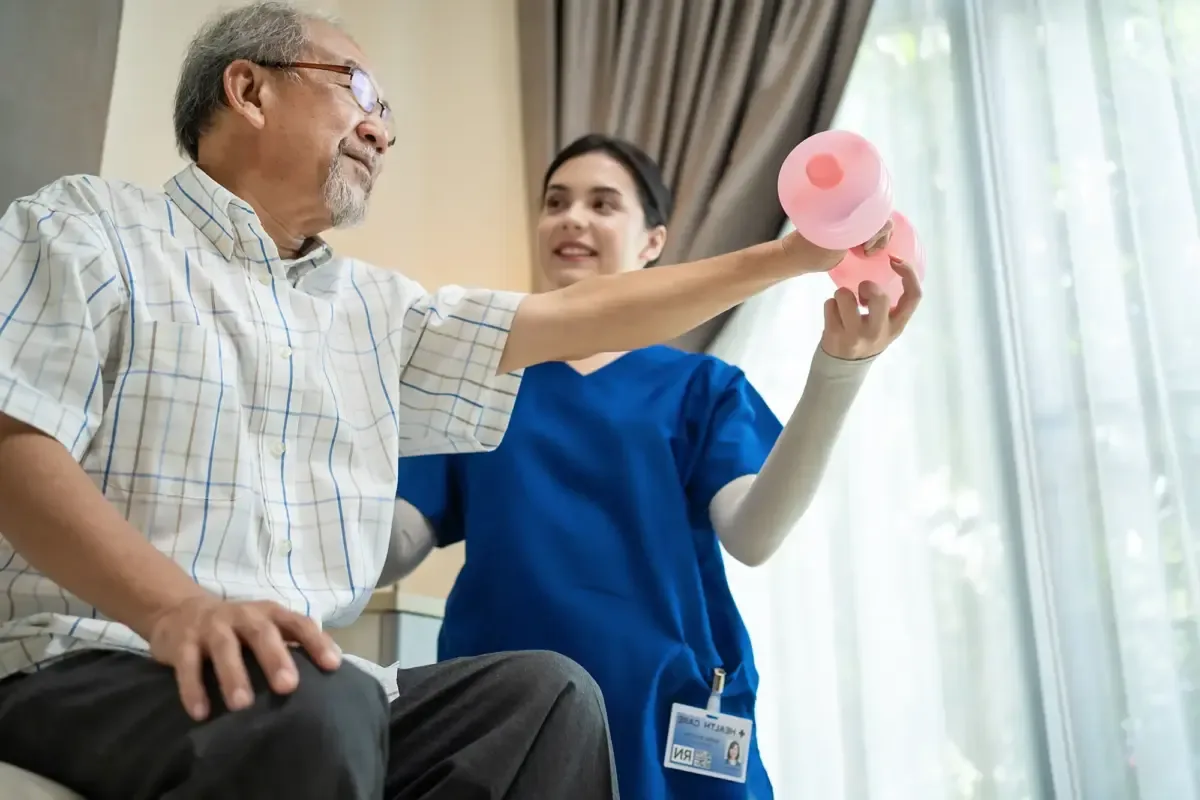
It starts with a cause-first evaluation that measures rather than guesses: how you stand up from a chair, how far and how steadily you walk, how much weight goes through the affected side, what your balance does when it is challenged, and how quickly you fatigue. Then you name the abilities that matter most to you, and the plan is built around those, one-on-one with a licensed physical therapist, every visit.
Calm it down.
Comfort and tone first: hands-on work and positioning for a tight, aching shoulder or calf, so the rest of the session is actually usable rather than spent guarding.
Restore what’s stuck.
Range of motion and controlled movement on the affected side, practised in the positions you actually use at home rather than only on a table.
Build strength you trust.
Progressive strength and endurance aimed at the tasks you named: standing up, crossing the room, carrying something in one hand, managing the front steps.
Make it stay fixed.
Balance and fall prevention, a home program sized to your energy rather than to an ideal week, and clear measures so the gains hold after the plan ends.
What does getting better look like?
Better after a stroke is not one thing, and it is not the same thing for two people. That is why the plan starts with you naming abilities rather than with us naming a result. Getting through the store without sitting down. Standing up from the low chair unassisted. Carrying a cup of coffee across the kitchen. Managing three front steps without a second person on the rail.
Those are the measures, and they are checkable. Some of them move within a few weeks. Some take much longer, and some do not come all the way back, which is the honest version and the one you deserve to hear before you start rather than after.
Left alone, the abilities that came partway back are usually the first to slip: the stride shortens, the stronger side quietly takes over more of the work, and the weaker side gets used less simply because it is easier not to.
An evaluation turns that into a plan with a specific estimate, reviewed with you at every phase and coordinated with your medical team. If unsteadiness on your feet is the main problem, balance and gait disorders covers that ground in more detail.
Which services treat stroke recovery?
Physical Therapy
Is the foundation: the evaluation that measures where you are, and the four-phase plan built around the abilities you name.
02Vestibular Therapy
Handles the balance and gaze retraining when unsteadiness and visual challenge are limiting how far you can safely walk.
03Orthopedic Therapy
Addresses the aching shoulder, the tight calf and the joint mechanics that often ride along with a recovering side.
04Blood Flow Restriction
Lets strength work start at light loads when heavy loading is not an option, which is common in the earlier phases here.
“Very friendly, knowledgeable staff. Therapists truly listen to problems and actively work to resolve them! Highly recommended!”Camille S. · Patient review
Questions, answered plainly.
The things families ask on the phone after a stroke, written down.
No, and nobody should tell you otherwise. Rehabilitation does not undo a stroke. What it does is train function: strength, balance, walking, endurance, and the specific everyday tasks you need back. Outcomes after a stroke vary enormously from one person to another, which is why an honest plan is built around abilities you name rather than around a promised result.
Not automatically. Recovery tends to move fastest in the early months, and it does not simply stop after them. What matters more than the calendar is whether there is a specific ability a plan can target, and whether you have lost ground that training can win back. An evaluation will tell you honestly whether there is. If the honest answer is that a course of therapy is unlikely to change much, we will tell you that too.
Yes, and it matters here more than on almost any other page of this site. Your physician manages the medical side of stroke care, including the conditions and medications behind it. We work on function, and we coordinate: we ask what your team has restricted, we send updates on your progress, and we raise anything we see that belongs with them rather than with us.
It depends on where you are starting and what you are working toward, more so than with most conditions we treat. Your therapist gives you a specific estimate at the evaluation, based on your own testing and the abilities you named, and reviews it with you at every phase. What you will not get here is a confident number invented before anyone has watched you walk.
Start with a cause-first evaluation of where you are now.
Put it in writing.
Six short questions. A real person calls you back, usually within two business hours, with times that fit your week.
The people who end up filling this out are rarely in the worst pain of their life. They’re just done working around it, done picking the errand that doesn’t require the stairs. If that’s the stage you’re at, this is the part where you stop researching and start.
Consider it filed.
A real person will call you back, usually within two business hours, with appointment times that fit your week. Keep your phone nearby.
Can’t wait? Call (724) 628-7288 ⟶Two clinics. Same standard in both.
Connellsville and Scottdale, both fully staffed, both easy to park at. Come see either one before you commit, if you like.
Clinic 01 · Connellsville
Directions to Connellsville ⟶ (opens in a new tab)
Clinic 02 · Scottdale
Directions to Scottdale ⟶ (opens in a new tab)