

Connellsville, PA · What we treat
Balance and gait disorders in Connellsville.
The stairs that suddenly need a handrail, the hand that goes out to the wall crossing a dark room: balance is a trainable skill made of four systems, and a cause-first evaluation finds out which one of yours has slipped.
You’ve probably said one of these.
Nobody walks in describing a gait deviation. They describe a handrail they never used to need. Tap one that sounds like your week.
-
UsuallyThe reflexive corrections you never had to think about have gotten slower, often after an illness, an injury, or a long stretch of much less walking than usual.
Why does this happen ⟶ -
UsuallyVision is carrying more of the balance work than it should, which shows the moment the lights go out and the other two systems have to hold it up alone.
Why does this happen ⟶ -
UsuallyA stride that has shortened and widened to feel safer, trading a little speed for a lot of caution, and then quietly becoming the way you walk.
Why does this happen ⟶
- “I walk close to the wall in a long hallway, just in case.”
- “I skipped the supper at church in January because of the parking lot.”
- “I caught myself on the counter last month and I didn’t tell anybody.”
If you’re reading this before anything has actually gone wrong, that isn’t worrying. That’s exactly the right week to be reading it.
Why do balance and gait change?
Staying upright is four systems agreeing with each other. Trouble usually means one of them has gone quiet and the others are covering. What we usually find, alone or in combination:
- Weakness in the hips and ankles. The two joints that make the hundreds of small corrections you never notice, and the first two to lose the strength to make them.
- Vestibular changes. The inner ear system that reports which way is up, altered by age, by an illness, or by an inner ear condition, so the signal arrives softer than it used to.
- Reduced sensation in the feet. Feet that tell you less about the ground they are on, so the correction starts late and has to be bigger when it does.
- Doing it all by eye. Vision quietly taking over the job, which is why the trouble shows up at night, on stairs, in a dim restaurant, and on uneven ground.
- Caution after a stumble. One near miss that shortens the stride and narrows the week, and less walking is precisely what makes balance slip faster.
None of these are diagnoses to make at home. If your evaluation turns up something that points to a medication effect or a neurological cause, we will tell you plainly and send you to a physician rather than starting a plan around it.
How do we treat balance and gait disorders in Connellsville?
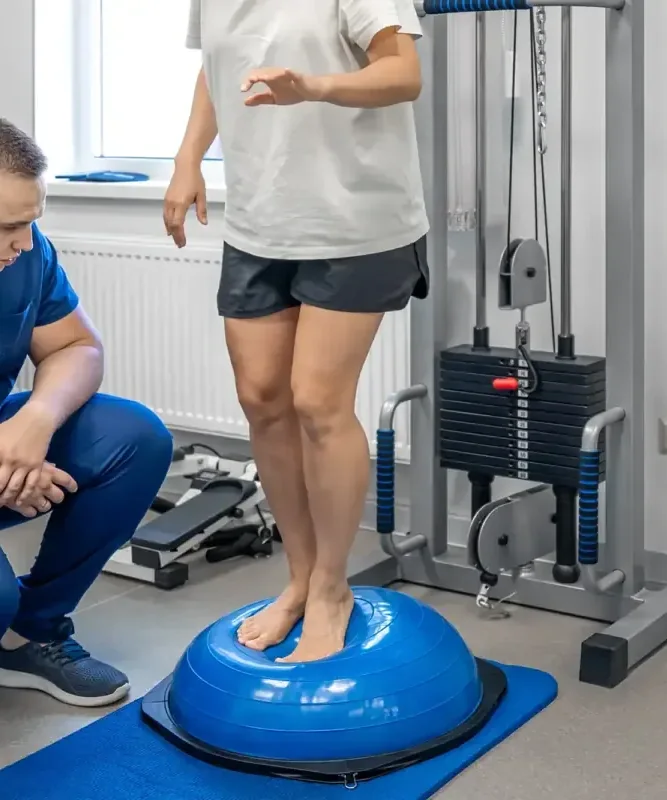
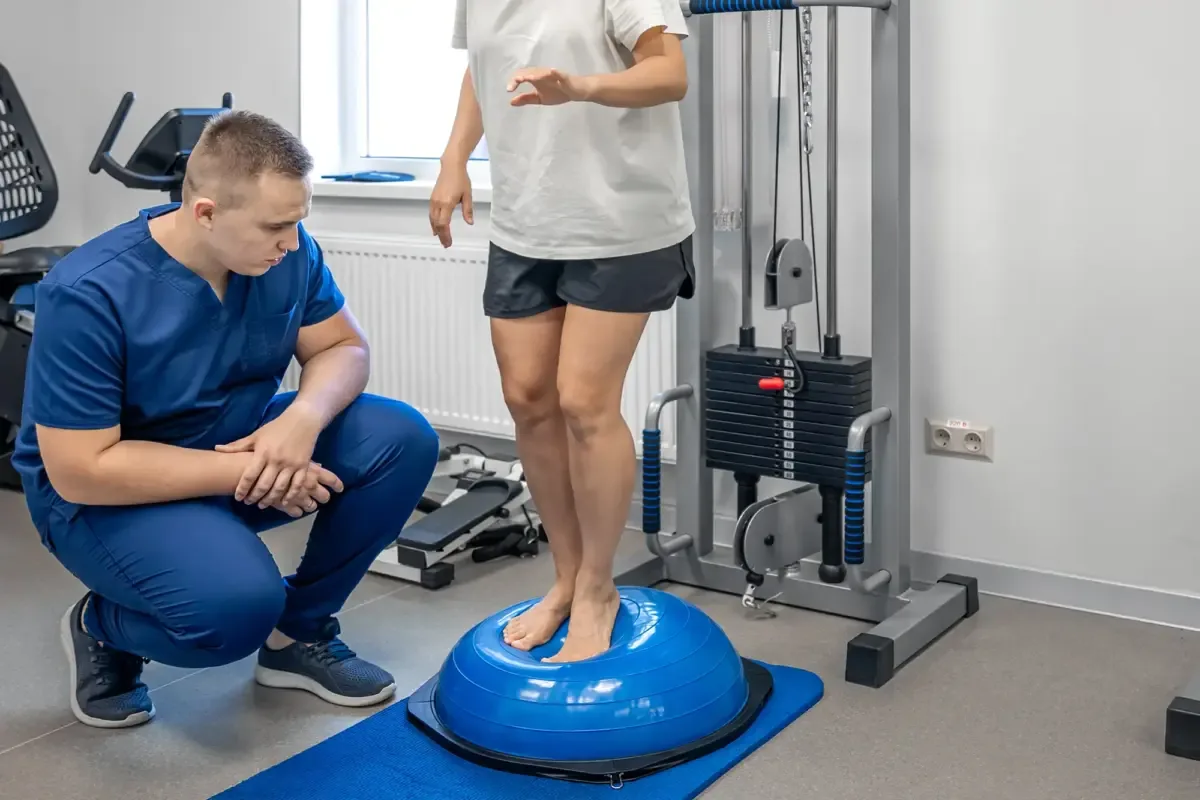
Treatment starts with a cause-first evaluation, because “bad balance” is a symptom and not a cause. Your therapist watches you walk, tests hip and ankle strength, challenges your standing balance in a controlled way with your eyes open and then closed, checks what your feet are reporting, and screens the inner ear system. The point is to find the weak link, not to hand you a generic exercise sheet.
From there, care moves through four named phases, one-on-one with a licensed physical therapist, every visit. Training is progressive and supervised: the challenge only goes up when the level below it is steady.
Calm it down.
Settle whatever is making movement hurt or feel unsafe first, hands-on where a stiff hip or ankle is part of it, so the training that follows is actually usable.
Restore what’s stuck.
Ankle and hip mobility back to what walking asks for, plus the inner ear and eye work when the screen points there, dosed to what you tolerate that week.
Build strength you trust.
Progressive hip and ankle strength, then balance trained the way life uses it: narrow bases, head turns, uneven ground, carrying something, standing up from a low chair.
Make it stay fixed.
Re-testing against the same measures you started with, a walk in the places that worried you, and a home program short enough that it actually gets done.
What does getting better look like?
Falls are the honest stake here, and they deserve to be named plainly rather than dramatically. A person who is steadier on stairs and on uneven ground is less likely to go down on them. That is the whole argument, and it does not need to be dressed up.
Most patients notice a difference within the first two or three visits, and it tends to show up in small, checkable places first: standing up from the low chair without pushing off the arms, turning around in the kitchen without a pause, crossing the room at night without the hand on the wall. Later it shows up as range: the parking lot, the church steps, the walk that got dropped a year ago and quietly never came back.
Left alone, an unsteady week tends to shrink the map: first the icy walk gets skipped, then the evening out, then the stairs, and less walking is the one thing guaranteed to make the balance slip faster.
An evaluation turns that into a plan with a specific estimate and measures you can watch move, reviewed with you at every phase. If your unsteadiness also comes with spinning or a floating feeling, start at dizziness and vertigo instead.
Which services treat balance and gait disorders?
Physical Therapy
Is the foundation: the cause-first evaluation and the four-phase plan that runs the whole course of balance and gait training.
02Vestibular Therapy
Takes over when the inner ear system is the weak link, retraining the signal that tells you which way is up.
03Orthopedic Therapy
Handles the stiff or painful hip and ankle underneath an unsteady stride, because a joint that will not move cannot correct.
04Blood Flow Restriction
Lets strength work start at light loads when heavy lifting is not an option yet, which is often the case here.
“Very friendly, knowledgeable staff. Therapists truly listen to problems and actively work to resolve them! Highly recommended!”Camille S. · Patient review
Questions, answered plainly.
The things people ask on the phone about being unsteady, written down.
A useful test is whether you have started editing your week. Holding a handrail you never used to hold, taking a hand along the wall in a dark hallway, skipping a parking lot in winter, or walking closer to the furniture all count. None of those are dramatic on their own, and together they are the pattern an evaluation is built to measure.
Some change is normal with age. Being unsteady enough to plan your day around it is not, and it is not something you have to accept. Balance is made of strength, inner ear signal, sensation in your feet and vision working together, and most of those respond to training. The evaluation finds out which part of yours has slipped before anything is trained.
No. Pennsylvania allows direct access, so you can book an evaluation without a physician's prescription. If what we find during the evaluation looks like it belongs with a physician first, a medication effect or a neurological sign for example, we will say so plainly and point you there rather than starting a plan.
You walk, and your therapist watches how. Then hip and ankle strength get tested, standing balance gets challenged in a controlled way with your eyes open and closed, sensation in your feet gets checked, and your inner ear system gets screened. It takes about 90 minutes, it is one-on-one with a licensed physical therapist, and you leave knowing which system is the weak link and what the plan is.
Start with a cause-first evaluation of your balance.
Put it in writing.
Six short questions. A real person calls you back, usually within two business hours, with times that fit your week.
The people who end up filling this out are rarely in the worst pain of their life. They’re just done working around it, done picking the errand that doesn’t require the stairs. If that’s the stage you’re at, this is the part where you stop researching and start.
Consider it filed.
A real person will call you back, usually within two business hours, with appointment times that fit your week. Keep your phone nearby.
Can’t wait? Call (724) 628-7288 ⟶Two clinics. Same standard in both.
Connellsville and Scottdale, both fully staffed, both easy to park at. Come see either one before you commit, if you like.
Clinic 01 · Connellsville
Directions to Connellsville ⟶ (opens in a new tab)
Clinic 02 · Scottdale
Directions to Scottdale ⟶ (opens in a new tab)