

Connellsville, PA · What we treat
Arthritis in Connellsville.
We cannot undo the change inside an arthritic joint, and we will not pretend otherwise. What a cause-first evaluation can do is find the strength, range, and habits that are making it cost more than it has to, then hand you a plan you keep rather than a course you finish.
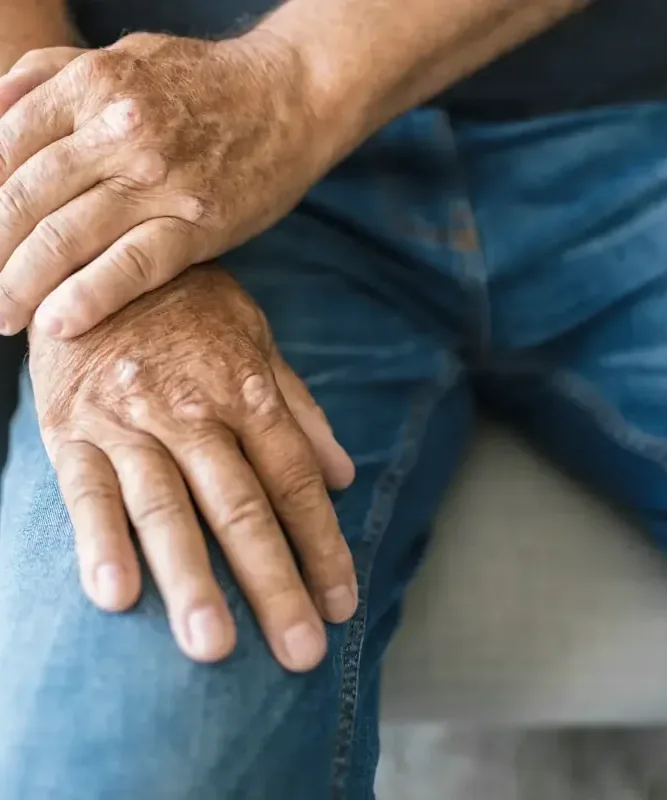
You’ve probably said one of these.
Nobody arrives quoting a radiology report. They describe the first half hour after getting up. Tap one that sounds like your week.
-
UsuallyThe classic morning stiffness pattern: a joint that settles overnight and needs movement, not rest, to loosen.
Why does this happen ⟶ -
UsuallyA joint that has narrowed its comfortable range, so any position held too long sits at the edge of it.
Why does this happen ⟶ -
UsuallyLost strength around the joint rather than the joint itself, and the most changeable thing on this page.
Why does this happen ⟶
- “A rainy week and I have an understanding, and it isn’t a friendly one.”
- “I stopped saying yes to anything that involves standing around for an hour.”
- “Somebody told me to rest it, so I did, and it got worse.”
If two or three of those sound like your week, you’re not describing an inevitability. You’re describing a pattern, and a pattern is something an evaluation can work with.
If you’ve been told to rest it and wait, and that answer never quite sat right with you, that isn’t stubbornness. That’s a fair reading of what we actually know.
Why does arthritis hurt more some weeks than others?
The diagnosis rarely explains the week. Two people with the same report can have very different Tuesdays, and the difference usually lives in this list:
- The joint change itself. Cartilage thins and the surfaces behave differently. This is the part therapy does not reverse, and it is worth naming first so the rest of the list is believable.
- Strength that left quietly. Muscle around a sore joint fades faster than most people realize, and every task then lands on the joint instead of the muscle. This is the single most changeable item here.
- Range you stopped using. A joint kept inside a small safe arc gets comfortable only inside that arc, and the arc keeps shrinking until an ordinary reach or step feels like the edge.
- Load that arrived too fast. A weekend of yard work after a quiet winter is not a moral failure. It is a dose problem, and dose problems are solvable.
- Sleep, stress, and general activity. None of these cause arthritis, but all of them change how loudly it reports. A bad fortnight of sleep will make a stable joint feel like a new problem.
None of these are diagnoses you make yourself, and a scan alone will not sort them out. Plenty of people have real joint change on imaging and almost no symptoms, and plenty have the reverse. That gap is exactly what the evaluation measures.

How do we treat arthritis in Connellsville?
Start with what we cannot do, because it makes everything else easier to trust. We cannot regrow cartilage, we cannot change what the report says, and we will not put a cure on the table. What we can change is the strength carrying the joint, the range you still own, the dose you can tolerate, and how a flare gets handled when one arrives. You work one-on-one with a licensed physical therapist, every visit.
The evaluation is cause-first: we test, not guess, and we test the whole limb rather than the sore spot. From there, care moves through four named phases, and the endpoint is a level of function you can hold on your own.
Calm it down.
Hands-on manual therapy, gentle movement through the range you have, and an honest look at what you did in the week before it got loud. Most patients notice a meaningful difference within the first few sessions.
Restore what’s stuck.
Reclaiming the range that stiffness quietly took, and restoring movement in the joints above and below that have been covering for the sore one.
Build strength you trust.
Graded loading against standards you clear before moving on. Strength is the part of this diagnosis that is genuinely negotiable, so it gets the most time.
Make it stay fixed.
A short program sized to your real week, a written plan for a bad week, and a clear standard for when it is worth calling us back rather than waiting it out.
What does getting better with arthritis look like?
Better here does not mean cured, and it is worth saying that in plain words before anything else. Arthritis is a long-term diagnosis. Nobody discharges you from it. What changes is how much room it takes up in an ordinary week.
Most patients notice a difference within the first two or three visits, since hands-on treatment starts at the evaluation itself. From there, progress shows up in ordinary places first. The morning half hour becomes ten minutes. You stop mapping the errand by the number of times you will have to stand back up. A rainy week is still a rainy week, but it costs you a day instead of a fortnight.
Left alone, an arthritic joint gets used a little less each month, and the strength around it goes quietly; by the time it aches on a flat sidewalk, there is more to rebuild than there was a year ago.
The endpoint we name at your evaluation is a level of function, not a cure, and a program you keep rather than a course you finish. Some people come back for a tune-up once or twice a year. That is a sensible way to use us, and we would rather see you for two visits in spring than for twelve in the fall.
Which services help most with arthritis?
Physical Therapy
The foundation: the cause-first evaluation and the four-phase plan that decides what gets loaded, how much, and how fast.
02Orthopedic Therapy
Measures range and strength on both sides so progress is a number you can see, rather than a feeling you have to trust.
03Manual Therapy
Hands-on work to settle a stiff, irritable joint enough that the strength work can actually begin, which is most of Phase I.
04Blood Flow Restriction
Builds strength at light loads, which is exactly the problem an irritable joint creates: the muscle needs weight the joint will not take yet.
“Kings has been a great place for myself or anyone that needs to receive physical therapy. My physical results have been improved and the staff and therapist are a pleasure to work with.”Joseph K. · Patient review
Questions, answered plainly.
The things people ask on the phone about arthritis, answered without the sales pitch.
No, and anyone who tells you otherwise is selling something. Arthritis is a change in the joint itself, and therapy does not reverse that change. What therapy can change is nearly everything around it: the strength that carries the joint, the range you have left, how much a flare costs you, and how many things on your list you still get to do. That is the honest offer, and for most people it is a much bigger difference than it sounds.
This is the most common worry we hear, and the fear is understandable. But joints are not tires. Loaded well and progressed sensibly, the tissue around a joint gets stronger and the joint itself tends to tolerate more, not less. The problem is not movement, it is movement that arrives too fast or too heavy for what you have been doing lately. Dosing that correctly is most of what your licensed physical therapist is for.
Neither is required to begin. No referral needed: Pennsylvania allows direct access, so you can book an evaluation without a prescription. Imaging is useful in some cases and misleading in others, since plenty of people have joint changes on a scan and no symptoms at all. If your evaluation turns up something that should be seen by a physician first, we will say so directly and point you there.
You leave with a program, not a goodbye. Because arthritis does not end, the endpoint of the plan is not a cure but a level of function you can hold on your own, plus a short routine sized to your actual week and a written plan for what to do on a bad one. Many people come back for a tune-up once or twice a year, and that is a reasonable way to use us rather than a sign anything went wrong.
Start with an honest evaluation of what arthritis is actually costing you.
Put it in writing.
Six short questions. A real person calls you back, usually within two business hours, with times that fit your week.
The people who end up filling this out are rarely in the worst pain of their life. They’re just done working around it, done picking the errand that doesn’t require the stairs. If that’s the stage you’re at, this is the part where you stop researching and start.
Consider it filed.
A real person will call you back, usually within two business hours, with appointment times that fit your week. Keep your phone nearby.
Can’t wait? Call (724) 628-7288 ⟶Two clinics. Same standard in both.
Connellsville and Scottdale, both fully staffed, both easy to park at. Come see either one before you commit, if you like.
Clinic 01 · Connellsville
Directions to Connellsville ⟶ (opens in a new tab)
Clinic 02 · Scottdale
Directions to Scottdale ⟶ (opens in a new tab)