

Connellsville, PA · What we treat
Foot and ankle pain in Connellsville.
A heel that hurts most in the first ten steps of the morning rarely has one clean explanation: a cause-first evaluation finds out why, then a plan with an endpoint gets you back to standing, walking, and lacing up without bracing for it first.

You’ve probably said one of these.
Nobody walks in describing plantar fasciitis. They describe the walk from the bed to the coffee pot. Tap one that sounds like your week.
-
UsuallyTissue under the arch that has run out of tolerance for static standing, so it complains until you move.
Why does this happen ⟶ -
UsuallyThe plantar fascia or the Achilles stiffening while you sit, then being asked to stretch out cold.
Why does this happen ⟶ -
UsuallyA capacity problem wearing a footwear disguise: the shoe changes the surface, not the tissue standing on it.
Why does this happen ⟶
- “Walking barefoot across the kitchen used to be nothing. Now it’s a decision.”
- “I roll it on ice most nights, just so the morning is a little less rough.”
- “The dog walk that used to clear my head now ends with me limping the last block.”
If two or three of those sound like your week, you’re not describing a mystery. You’re describing a pattern we see often, and one an evaluation is built to explain.
If you’ve been quietly rearranging your day around the first ten steps rather than mentioning it to anyone, that isn’t toughness. It’s just a habit that has outlived its usefulness.
Why does foot and ankle pain happen?
There’s rarely one single cause, which is exactly why guessing doesn’t work. What we usually find, alone or in combination:
- Plantar fasciitis. The band of tissue along the bottom of the foot, irritated enough to make the first steps out of bed or off the couch the worst part of the day.
- Achilles tendinitis. The tendon at the back of the heel, usually overloaded by a sudden jump in mileage, a new job on your feet, or a return to running after a long gap.
- An old sprain that never fully settled. Ligaments that healed loose or underpowered, leaving the joint quick to roll again and quietly unreliable on uneven ground.
- Mechanics and load. How the foot strikes and rolls, often changed by new footwear, a new surface at work, or simply more standing hours than the foot is conditioned for.
- Deconditioning of the calf. The single biggest engine under the foot, quietly losing capacity after months of less walking than usual, so every step costs more than it should.
None of these are diagnoses you make yourself, and most don’t require imaging to start treating. That’s what the evaluation sorts out.
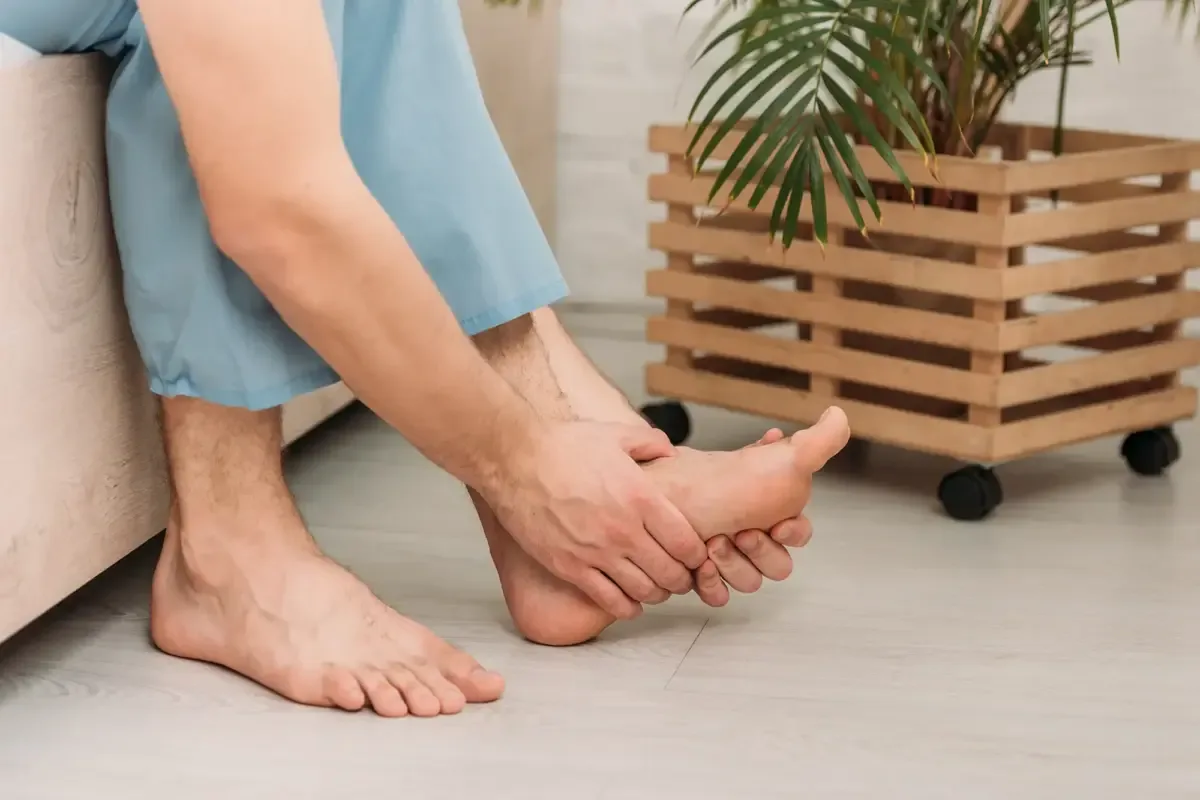
How do we treat foot and ankle pain in Connellsville?
Treatment starts with a cause-first evaluation: testing how the foot, the ankle, and the calf move and load together, not just pressing on the spot that hurts, because where it hurts isn’t always why it hurts. You work one-on-one with a licensed physical therapist, every visit. From there, care moves through four named phases.
The plan’s endpoint is named at your evaluation and reviewed with you every phase, because the goal is to get you back to your week, not to keep you on the schedule.
Calm it down.
Hands-on manual therapy for the arch and calf, plus a temporary change to the surfaces and shoes you spend the most hours in. Most patients notice a meaningful difference within the first few sessions.
Restore what’s stuck.
Mobility work for the ankle joint and the calf that is actually limiting how far forward you can travel over the foot, dosed to what the tissue tolerates that week.
Build strength you trust.
Progressive calf, arch, and balance work against standards you clear before moving on, so standing a full shift and walking the long way become load-tolerant again, not just quiet.
Make it stay fixed.
Testing before you’re cleared, then a home program sized to your real week, plus honest coaching on the footwear and the surfaces that keep reloading the same tissue.
What does getting better from foot and ankle pain look like?
People who book an evaluation for a foot or an ankle are rarely the ones who rolled it once and stopped. More often it is a slower story: a year of new insoles, skipping the long walk, deciding the limp in the first few steps is simply how mornings go now.
Most patients notice a difference within the first two or three visits, since hands-on treatment starts at the evaluation itself rather than a week later. From there, progress tends to show up in ordinary places first. Standing at the sink without shifting your weight. Crossing the kitchen barefoot without thinking about it. Finishing the dog walk at the same pace you started it.
Left alone, an irritated foot teaches you to walk around it, and the limp you adopt to protect one heel becomes the reason the other side starts complaining six months later.
An evaluation turns that guesswork into a plan with a specific estimate, reviewed with you at every phase. No referral needed: Pennsylvania allows direct access, so you can start with us.
Which services treat foot and ankle pain?
Physical Therapy
The foundation of treatment: the cause-first evaluation and the four-phase plan that runs the whole recovery.
02Manual Therapy
Hands-on work for the arch, the calf, and a stiff ankle joint, which is most of what Phase I and Phase II look like here.
03Dry Needling
Targets the calf guarding that builds up around an irritated Achilles or plantar fascia when it isn’t releasing with hands alone.
04Astym
Used on stubborn tendon and fascia tissue that has been irritated long enough to stop responding to hands and exercise alone.
“Very professional and friendly staff. Through their knowledge and expertise on my specific injury, they made my recovery a very successful one! They were there every step of the way during the process from answering all my questions about my injury, questions about my post surgical procedure and recovery time. They really took the time and made me feel like family. I would recommend King Physical Therapy to my family and friends.”Lori C. · Patient review
Questions, answered plainly.
The things people ask on the phone about a sore foot or ankle, written down.
Most foot and ankle pain isn’t a medical emergency, but “serious” isn’t something to guess at from home. Sometimes the pain fades while the cause stays, which is why it returns every time you stand a long shift, walk further than usual, or wear the wrong shoe, often lasting a little longer each round. An evaluation tells you what you’re actually dealing with, and if anything looks like it needs a physician first, we’ll say so and point you there directly.
In plain terms: plantar fasciitis is irritation along the band of tissue under the arch, Achilles tendinitis is an overloaded tendon at the back of the heel, and an old sprain is a joint that healed loose and never got its strength back. They overlap often, which is why the evaluation tests movement, balance, and calf strength instead of guessing from the one spot you can point at.
Sometimes footwear is part of the answer, and your licensed physical therapist will tell you plainly if it is. But a shoe changes the surface under the problem, not the capacity of the tissue standing on it. If the calf and foot are underpowered for the hours you ask of them, the fourth pair of shoes this year will feel good for about two weeks. The strength work is what holds.
Usually, yes, with modifications your licensed physical therapist gives you at the evaluation. Surfaces, distances, and footwear get adjusted for a phase, then reintroduced once you’ve cleared the standard for that phase. Very few people are told simply to rest, because tissue that is never loaded does not get stronger, and standing still is its own kind of load.
Start with a cause-first evaluation for your foot or ankle.
Put it in writing.
Six short questions. A real person calls you back, usually within two business hours, with times that fit your week.
The people who end up filling this out are rarely in the worst pain of their life. They’re just done working around it, done picking the errand that doesn’t require the stairs. If that’s the stage you’re at, this is the part where you stop researching and start.
Consider it filed.
A real person will call you back, usually within two business hours, with appointment times that fit your week. Keep your phone nearby.
Can’t wait? Call (724) 628-7288 ⟶Two clinics. Same standard in both.
Connellsville and Scottdale, both fully staffed, both easy to park at. Come see either one before you commit, if you like.
Clinic 01 · Connellsville
Directions to Connellsville ⟶ (opens in a new tab)
Clinic 02 · Scottdale
Directions to Scottdale ⟶ (opens in a new tab)